
Table of Contents
July 8 EST: You can’t coach what Amanda Anisimova has in her. The instincts? Sure, honed. The power? Built. But the steel—the stuff that gets you through match points and mourning? That’s born, and maybe, just maybe, inherited.


The Game Before The Game
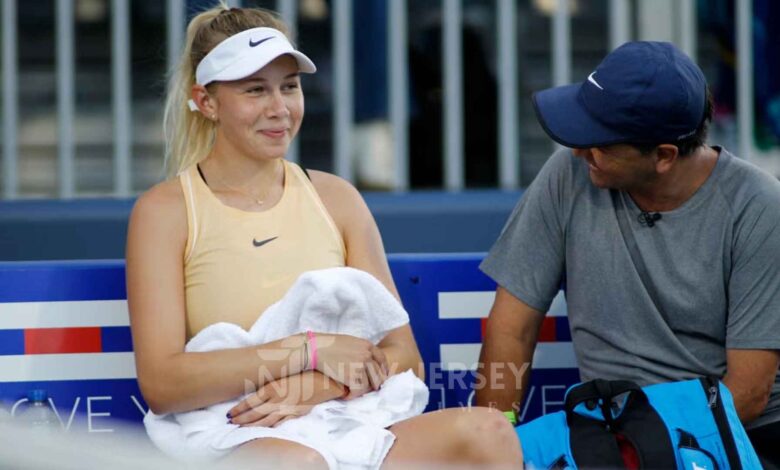
Long before she was dropping seeded players at Roland Garros or cracking serves like a veteran twice her age, Amanda was just a little girl in Florida, getting fed balls by her father on sunbaked courts in Aventura. No elite academy. No celebrity coach. Just Konstantin Anisimov, a Russian émigré who swapped finance for forehands, turning fatherhood into a masterclass in grassroots tennis.
It wasn’t supposed to be Amanda’s story, at first. Maria, the older sister, was the family’s first hope—a rising junior who landed at Penn and studied at Wharton. The whole family moved from Russia to New Jersey in 1998 to give her a better shot. Then they headed south for year-round tennis and a second daughter who was watching closely.
And then, boom—Amanda picks up a racket, and everything changes.
Built by a Banker, Sharpened by Fire
Konstantin had never coached a day in his life before Amanda. Didn’t matter. The guy had resolve. He taught Amanda the game like it was gospel—movement, precision, toughness. Five years old and already drilling like a pro. He ran her sessions, planned her travel, shaped her strokes. No entourage, just dad. Olga, her mother, handled the rest—home, logistics, everything in between. This was a unit. A full-court press of parental belief.
And it worked. Amanda climbed the junior ranks like she had rocket fuel in her laces. She had ice in her veins, clean technique, and that rarest of tennis gifts: time. She made the court look wider, slower, more manageable than it is for most. You could tell early—this wasn’t just a prodigy. This was a player.
The Point You Never Want to Play
Then came August 2019, and the kind of heartbreak no stat line can soften. Just weeks after Amanda reached the semifinals of the French Open, just as the U.S. Open loomed, Konstantin died of a heart attack. He was 52. Gone in an instant. Amanda was 17.
She pulled out of the Open. Of course she did. What kind of world asks you to play through that?
There’s no blueprint for how to come back from that. Not in tennis. Not in life. But somehow, Amanda did. Slowly. Quietly. She found her footing again, leaned on her mother, kept her father’s lessons close. Even now, her rhythm on court—calm, sharp, surgical—feels like him. He’s still there in the way she takes the ball early, the way she refuses to panic.
When You Come From Fire, You Play With Smoke
Anisimova isn’t the loudest. She’s not built for viral clips or mid-match meltdowns. She doesn’t need to be. Her game hums with control. There’s no wasted motion, no empty drama. Just weight behind the ball and intention in every shot.
And when she’s on? Good luck. That 2019 Roland Garros run wasn’t some fluke. She took out Simona Halep, for God’s sake. Straight sets. Ice-cold. She was the youngest American to reach a Grand Slam semifinal since Serena in 1999. That’s not a stat, that’s a headline.
But life hasn’t lined up neatly for Amanda since. There’ve been dips, breaks, whispers about burnout. In 2023, she took a mental health hiatus. And fans—true fans—understood. Because you can’t play through grief forever. At some point, it catches your breath.
She’s Not Just Her Ranking—She’s Her Resolve
Amanda Anisimova’s story doesn’t fit neatly on a ranking chart. It doesn’t care if she’s seeded or not. What she’s done—rising with no academy, no big-name backing, losing her coach-father at the peak of her ascent—that’s not tennis, that’s life.
And yeah, we root hard. Because we saw the start. Because we felt the loss. Because when she rips a backhand down the line, it’s not just skill—it’s memory, momentum, and the echo of a dad in a folding chair calling out encouragement across the court.
Anisimova’s still young. Still building. Still coming back.
But make no mistake—she’s already played the toughest match of her life. And she’s still standing.
New Jersey Times Is Your Source: The Latest In Politics, Entertainment, Business, Breaking News, And Other News. Please Follow Us On Facebook, Instagram, And Twitter To Receive Instantaneous Updates. Also Do Checkout Our Telegram Channel @Njtdotcom For Latest Updates.

A former college-level cricketer and lifelong sports enthusiast, Arun Upadhayay brings the heart of an athlete to the sharp eye of a journalist. With firsthand experience in competitive sports and a deep understanding of team dynamics, Arun covers everything from grassroots tournaments to high-stakes international showdowns. His reporting blends field-level grit with analytical precision, making him a trusted voice for sports fans across New Jersey and beyond.