
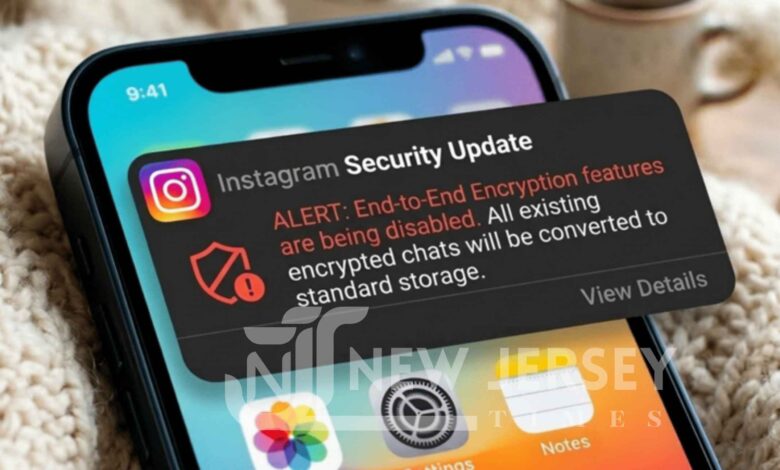
Newark, May 8: So here is what happened this morning.

Instagram killed end to end encryption for direct messages. No warning. No explanation. No pop up asking if you were okay with it. Just gone and your 3.3 billion fellow users found out the same way you probably did. Someone in a group chat sent the link.
Think about that for a second. One of the biggest privacy changes Meta has ever made to Instagram, and the company said absolutely nothing.
The Lock Is Gone Here Is What That Actually Means
Most people hear “end to end encryption” and their eyes glaze over. Fair enough. So here is the version that actually matters.
When E2EE was on, your DMs were scrambled the second you hit send. By the time your message touched Meta’s servers, it was unreadable. To everyone. Including Meta itself.
The company literally could not hand your messages to a government even if it wanted to. There was nothing readable to hand over.
That is done now. Your messages travel through Meta’s systems the same way a postcard travels through the mail. Anyone handling it along the way can read what is written on it.
And you probably sent a few this morning without knowing any of this had changed.
So Why Did Meta Do This?
That is the question worth sitting with because the company has been unusually quiet about it.
Sources talking to Wired off the record pointed to two things. One was pressure from European regulators under the Digital Services Act, which has been pushing platforms hard to take responsibility for what moves through their systems.
The other was something more uncomfortable. Meta genuinely struggled to catch serious criminal content including child sexual abuse material inside encrypted chats. That is a real problem. Nobody serious is dismissing it.
But privacy advocates have argued for years that there are smarter ways to address that without cracking open every private conversation on the platform. Meta apparently ran out of patience with that argument.
Then there is the part nobody at Meta will say out loud.
The company makes its money from knowing things about you. An encrypted inbox was always a room in the house where the lights were off. Starting today, the lights are on.
What Are the Implications of Ending Direct Message Encryption on Social Media Platforms?
Here is where it gets real.
Most people will shrug and say they have nothing to hide. That response misses the point completely.
Think about who actually needed this feature to work. The reporter texting a whistleblower. The woman quietly making plans to leave a dangerous relationship. The teenager working out who they are in a home where that conversation would go badly. The activist in a country where the wrong opinion posted publicly carries real consequences.
For those people, encrypted DMs were never about hiding something wrong. They were just about being safe.
And there is another layer to this that does not get talked about enough. The moment people know their messages can be read, they start writing differently. More carefully. More cautiously. They stop saying what they actually mean.
Meta does not even need to open a single message for that shift to happen. The knowledge that it could is already enough to change how people communicate.
Impact on Personal Message Privacy on Social Platforms
Here is the honest reality check.
Instagram is not actually alone in this. Facebook Messenger has never encrypted messages by default. X does not. Snapchat does not. The uncomfortable truth is that most of the places people have private conversations online have never been truly private.
What made today different is the direction of travel.
Instagram had moved toward privacy in 2023. Users noticed. People started treating DMs differently more candidly, more personally, with the kind of openness you only get when you feel like nobody else is watching.
That trust got built up over two years. It just got dismantled in a policy update most users never saw.
From this point forward every message you send on Instagram is, in plain legal terms, readable corporate data. Meta can scan it. A government can subpoena it. A breach can expose it.
If you would not say it loudly in a coffee shop, it probably should not go in an Instagram DM anymore.
Europe Is Not Letting This Go Quietly
Across the Atlantic, the mood is noticeably less relaxed about all of this.
The Irish Data Protection Commission the regulator responsible for overseeing Meta across the entire EU, because the company decided to plant its European headquarters in Dublin told The Register it is “monitoring developments.”
Translated from regulator language: they are building a case file and waiting to see how this plays out.
Over in Germany, the federal data protection authority had reportedly already been briefed on the change before it went live, according to Süddeutsche Zeitung. That is not a coincidence. German regulators have gone after Meta before and they do not tend to make noise without eventually following through.
Meta seems to be betting that right now with governments everywhere hammering on online safety and child protection is the ideal moment to make this kind of move without serious blowback.
Maybe they are right. Or maybe they have just handed European regulators the cleanest case against them in years.
Which Messaging Apps Still Offer End to End Encryption After This Change?
Good news there are still genuinely good options. They just are not Instagram.
Signal is the one name that comes up every time this conversation happens, and honestly it deserves the reputation.
It is built by a non profit. Funded by donations rather than ad money. Everything you send messages, calls, photos, voice notes is encrypted end to end and stays that way. Independent researchers have picked it apart looking for weaknesses and mostly walked away impressed. There is no business model here that benefits from knowing what you say.
WhatsApp still encrypts everything by default. Sources speaking to The Verge this week said no changes are in the pipeline. Worth knowing though WhatsApp still tracks a significant amount of metadata. It may not know what you said but it knows who you talk to, how often, and roughly when. That is more information than it sounds like.
Apple’s iMessage works well if everyone you are talking to is on an Apple device. The moment an Android user joins the thread, the encryption disappears and you drop into basic unprotected SMS without any warning.
Telegram keeps coming up in these discussions and it really should not have the privacy reputation it has. Standard Telegram chats are not end to end encrypted. Only “secret chats” are and you have to manually switch that on every single time. Most people never do.
If real privacy is what you are after, Signal is genuinely where the answer lives.
What Privacy Groups Are Actually Saying
The reaction from the people who track this stuff for a living was fast and it was not polite.
The Electronic Frontier Foundation put out a statement within hours calling it “a significant regression in user privacy.” They were particularly pointed about the people who get hurt most journalists, survivors of abuse, activists, and anyone who was using private messaging not for fun but for actual safety.
Access Now went further and just said the quiet part loud.
“Assume that anything you send via Instagram today can be read by Meta, its partners, or a government agency tomorrow,” they said, according to Al Jazeera.
What makes this sting a little more than a standard policy change is the context around it.
Instagram spent years building its identity around the intimacy of the DM. The whole cultural language of sliding into someone’s messages, of having real conversations away from the public timeline Meta’s own marketing teams cultivated that. Deliberately.
The asterisk was just never written in a font size anyone could read.
How Does the Removal of DM Encryption Affect User Privacy on Popular Social Apps?
More than most people are going to realize until it affects them personally.
Losing end to end encryption is not just one thing going wrong. It is several things at once.
You lose the privacy of what you are writing right now. You lose what security people call forward secrecy which meant that even if Meta’s servers were compromised someday, your old messages would still be unreadable. That protection is gone too.
And you lose the quiet confidence that comes with knowing a conversation genuinely belongs to you.
Look at the map right now. WhatsApp and iMessage still encrypt by default. Instagram, Facebook Messenger, Snapchat, and X do not.
The part that worries people who watch this space is not even specifically about Meta.
It is about what every other platform just watched happen. A company with three billion users quietly removes a privacy protection. The world keeps scrolling. What conclusion does every other company draw from that?
Secure Alternatives for Private Messaging
If this story has made you want to rethink where you actually have private conversations, the honest answer is good, you probably should.
Signal is the place most security researchers would point you first. Free. Open source. Run by people whose business model does not involve selling anything about you. Full encryption on everything, switched on by default. Get it. Convince the people you actually need to talk privately with to get it too.
Threema is worth knowing if you want to go even further.
No phone number required. You sign up with a random ID. There is a small one time cost and that cost is kind of the point. No ads means no pressure to know anything about you.
Proton Mail covers private email. Swiss based, Swiss law, and a genuine track record of pushing back when governments come asking for data rather than just quietly handing it over.
For everyone who is not ready to leave Instagram which is most people and that is completely understandable just change how you think about DMs on the platform.
Treat them like a conversation at a table in a restaurant where you are not sure who is sitting nearby. Keep the personal stuff somewhere else.
It looks like a lot of people are already figuring this out without being told.
Bloomberg reported this morning that Signal shot up into the top 10 of the Apple App Store across multiple countries within hours of this news going wide. No ad campaign. No influencer push. Just people reading the headlines and making a quiet decision.
That reaction says more about how people actually feel about this than anything Meta is going to put in a press release.
New Jersey Times Is Your Source: The Latest In Politics, Entertainment, Business, Breaking News, And Other News. Please Follow Us On Facebook, Instagram, And Twitter To Receive Instantaneous Updates. Also Do Checkout Our Telegram Channel @Njtdotcom For Latest Updates.

A Wall Street veteran turned investigative journalist, Marcus brings over two decades of financial insight into boardrooms, IPOs, corporate chess games, and economic undercurrents. Known for asking uncomfortable questions in comfortable suits.

Trained in war zones, raised in Newark, and seasoned in city hall, Jordan blends grit reporting with deep integrity. From floods to finance bills, they’re always first on scene and last to leave.