Trump, Marcos Edge Toward High-Stakes Trade Pact as Indo-Pacific Chessboard Shifts
Philippine President Marcos Jr. and President Trump signal deeper economic and military alignment as Washington eyes tighter control in Southeast Asia.

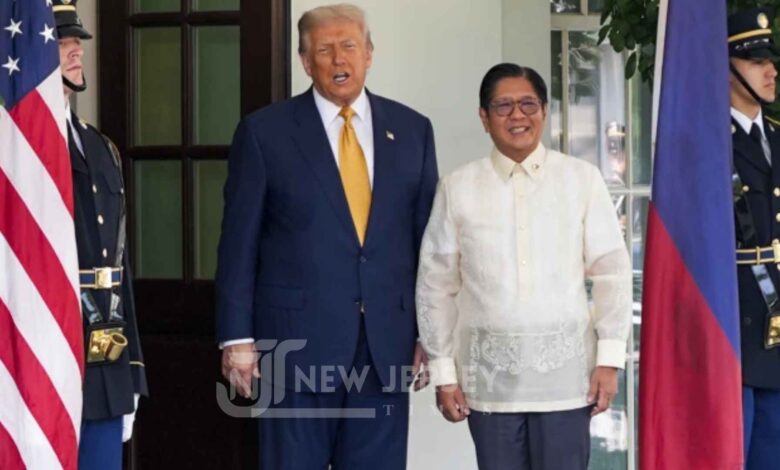
Washington, July 22 EST: President Donald Trump isn’t just hosting foreign leaders he’s drawing lines. And on Monday, with Philippine President Ferdinand “Bongbong” Marcos Jr. standing beside him at the White House, the message was unmissable: The United States is tightening its grip on the Indo-Pacific, and Manila is no longer playing both sides.

Trump declared that a “very big” trade deal with the Philippines was close perhaps weeks away. But the real news lay in the subtext. In a rare move for a U.S. president, Trump simultaneously promised a “zero-tariff” open market arrangement while also imposing a 19% tariff on Philippine goods, exposing the White House’s evolving definition of reciprocity.
“We are very close,” Trump said of the deal, but when asked if it would get done, his confidence came wrapped in characteristic ambiguity: “I think we will.”
The phrasing was vintage Trump vague enough to hedge, firm enough to signal leverage. It also speaks to a deeper reality: this is not just a trade negotiation. It’s a test of loyalty.
What the Tariff Really Means
Let’s be clear—this isn’t a free trade agreement. It’s a protectionist pact draped in the language of partnership. Trump’s 19% tariff on Philippine imports fits neatly into his broader Southeast Asia playbook, echoing new terms recently floated to Vietnam (20%) and Indonesia (19%).
The policy isn’t built on economic orthodoxy. It’s built on the belief that America, having allowed too much for too long, must now make others pay to play. Trump calls this “fair.” Economists call it selective decoupling. Either way, it tilts the table.
The Philippines, which ran a $5 billion goods trade surplus with the U.S. last year, has reason to be cautious. Marcos wants a deal badly but not at the expense of Filipino exporters who already face rising global headwinds. He’s under pressure at home to secure terms that don’t just serve Washington’s agenda.
“Equity is what we’re here for,” said one Philippine official close to the talks. That comment, more than any from the podium, captured the balancing act Marcos is attempting.
The Military Card: Always in Play
Trump didn’t just talk trade. He made clear that the U.S.–Philippine alliance, long overshadowed by Duterte-era flirtations with Beijing, is back in strategic vogue.
Calling the Philippines “a very important nation militarily,” Trump pointed to recent joint drills in the South China Sea as proof of restored alignment. The exercises involved U.S. and Philippine naval forces working in contested waters waters China insists it controls.
Marcos, for his part, held closed-door talks with Defense Secretary Pete Hegseth and Secretary of State Marco Rubio, suggesting this visit was about more than smiles and handshakes. Sources say the discussions touched on base access, equipment upgrades, and regional intelligence sharing.
This military dimension is not peripheral it’s central. Trump’s second term is recalibrating U.S. power in Asia through bilateral leverage rather than multilateral forums. Marcos, knowing the stakes, appears willing to play the long game if the returns justify the risk.
Beyond the Optics: A New Cold Calculation
Marcos is the first Southeast Asian leader to be received at the White House under Trump’s second administration, and that’s not a coincidence.
With China asserting itself across the South China Sea and deepening ties with Russia and Iran, Washington is fortifying its own perimeter starting with allies that can both project power and take orders.
In this climate, the Philippines becomes more than a trading partner. It becomes a staging ground.
Unlike his predecessor Rodrigo Duterte, who leveraged the U.S.–China rivalry for domestic gain, Marcos is choosing a lane and the consequences will be generational.
A Deal Built on Power, Not Parity
Trump’s version of a “deal” rests on a basic premise: America gets what it wants up front. Others get access—on Washington’s terms.
It’s a model that breaks with the Clinton-Bush-Obama legacy of global integration and leans instead on hard-edged bilateralism. And for the Philippines, the offer on the table is simple but steep: pay the 19% tariff, get U.S. market access, and receive strategic cover.
Critics in Manila worry that Trump’s tariff-first stance could gut key industries. U.S. analysts warn it may provoke blowback from other ASEAN states. But inside the Beltway, few doubt the model’s durability.
In the short term, Marcos is likely to accept a version of this deal. But over the longer horizon, the Philippines risks being boxed into a rigid trade-security paradigm one that leaves little room for independent maneuvering.
The Clock Is Ticking
Negotiators from both governments now have less than a month to finalize a framework. Philippine officials say any agreement will need at least partial ratification by their legislature. U.S. sources say Trump could push it through via executive action, bypassing a divided Congress.
This wouldn’t be the first time. Trump has previously used executive tools to reset trade terms with Mexico, Canada, and Japan with mixed results.
Still, if sealed, this would be his most consequential deal in Asia since scrapping the Trans-Pacific Partnership in 2017.
What’s Really at Stake
This isn’t just about tariffs or treaties. It’s about who sets the terms in a region where American influence is no longer assumed.
Trump and Marcos both understand the optics. But behind closed doors, this is a negotiation between a global hegemon asserting leverage and a regional leader seeking relevance without subservience.
The trade deal may be close, but the power calculus is already in motion.
New Jersey Times Is Your Source: The Latest In Politics, Entertainment, Business, Breaking News, And Other News. Please Follow Us On Facebook, Instagram, And Twitter To Receive Instantaneous Updates. Also Do Checkout Our Telegram Channel @Njtdotcom For Latest Updates.

A political science PhD who jumped the academic ship to cover real-time governance, Olivia is the East Coast's sharpest watchdog. She dissects power plays in Trenton and D.C. without bias or apology.