Trump Redefines Commander in Chief Role as Hegseth Reshapes Military
Trump pushes domestic military authority while Hegseth launches sweeping Pentagon reforms, sparking alarm over civil-military balance.


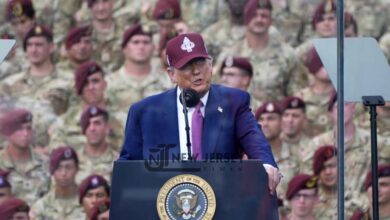
Trenton, September 30 EST: At Marine Corps Base Quantico on Tuesday, Donald Trump stood before the military’s top brass and made a declaration that was at once familiar and unsettling. “There could be no higher honor than to serve as your commander in chief,” he told the room. Then he pushed further, casting himself not just as the nation’s civilian leader but as a general-in-chief prepared to wage battle against “the enemy within.”


It was the kind of line that lands with thunder inside a hall of uniforms but sounds far more ominous beyond the base gates. Trump wasn’t simply talking about foreign adversaries. He was talking about American cities, American movements, and American citizens.
Turning Cities Into Training Grounds
The former president-turned-president-again mused aloud about using urban centers as “training grounds” for the armed forces, citing Chicago by name. It was half policy suggestion, half provocation. But the signal was clear: in Trump’s view, the domestic front can be folded into the battlefield.
That is not entirely without precedent. Dwight Eisenhower federalized the Arkansas National Guard to enforce desegregation in Little Rock in 1957. George H.W. Bush sent troops to Los Angeles during the 1992 riots. But those were moments of acute crisis, not standing policy. Trump, by contrast, appears eager to normalize the notion that federal troops belong in the city streets as a matter of routine preparedness.
Governors wasted no time rejecting the idea. Illinois’ J.B. Pritzker said flatly that his state “will not be used as a war game.” The pushback echoed through Democratic strongholds and swing states alike, setting up what could become another high-stakes test of state-federal power.
Hegseth’s Counter-Revolution Inside the Pentagon
If Trump is flexing the political side of commander in chief, Defense Secretary Pete Hegseth is handling the cultural revolution inside the ranks. Hours after Trump’s speech, Hegseth unveiled ten new directives that read like a scorched-earth reversal of two decades of Pentagon reform.
Fitness standards tightened. Diversity and harassment training cut back. Climate and extremism courses shelved. Grooming codes reinstated. In Hegseth’s telling, these moves are about returning the military to warfighting primacy. But his words were not those of a neutral manager. “The commander in chief has your back,” he declared, adding barbs about “fat generals” and a force distracted by “equity fads.”
Here, too, the comparison to history matters. Post-Vietnam, the Pentagon worked painstakingly to reframe the military as a professional, apolitical institution, insulated from culture wars. Hegseth is torching that consensus in real time. His reforms are less about logistics than about signaling: the new War Department will mirror Trump’s politics, not resist them.
A Strain in Civil-Military Balance
There is a reason senior officers greeted the day’s events with what Reuters described as “tight-lipped professionalism.” They’ve been through versions of this before. During the Trump presidency’s first term, generals found themselves navigating the president’s demands for loyalty, his disdain for dissent, and his occasional musings about deploying the military for partisan ends.
This time feels different. Trump is not hedging. He is embracing the idea that the military is his instrument — not the nation’s, his. And Hegseth is putting institutional weight behind that framing.
Critics in Congress have already taken notice. Senator Tammy Duckworth, who lost both legs flying helicopters in Iraq, was blunt: Hegseth’s reforms “gut professionalism in service of Trump’s ideology.” Others warn that Trump’s repeated invocation of “the enemy at home” veers dangerously close to criminalizing dissent.
Echoes and Departures From History
American history is littered with tense moments between presidents and generals. Harry Truman firing Douglas MacArthur for insubordination in Korea. Richard Nixon leaning on the military during Watergate. Barack Obama navigating a skeptical Pentagon during the Afghanistan surge.
But what Trump is doing now is less about conflict with the military than about subsuming it. He’s not fighting his generals; he’s daring them to follow him into a space where the U.S. military is both sword and shield of a domestic political project.
That distinction matters. Civil-military scholars note that the military’s apolitical standing has been one of the country’s most stabilizing norms. Undoing it, even subtly, can have long consequences. Once the ranks are politicized, they rarely depoliticize without deep institutional trauma.
A Battle of Legitimacy Ahead
What happens next depends less on Trump’s words than on whether he tries to act on them. If he orders federal troops into cities as “training grounds,” governors will resist and the courts will be dragged in. If Hegseth’s reforms go through, recruitment, retention, and internal morale may be the first stress tests.
The military, for its part, will be reluctant to show open defiance. Its ethos demands obedience to civilian control. Yet behind closed doors, officers and enlisted alike are asking a quiet question: obedience to whom? The Constitution or the commander in chief who claims to embody it?
That tension is not theoretical. It cuts to the heart of America’s experiment in republican government. The framers granted the president command of the military precisely to prevent a standing generalissimo. But they also assumed presidents would understand the gravity of wielding that power.
Trump, it seems, has no such qualms. And that is why this moment feels less like a policy fight and more like a test of the constitutional guardrails themselves.
New Jersey Times Is Your Source: The Latest In Politics, Entertainment, Business, Breaking News, And Other News. Please Follow Us On Facebook, Instagram, And Twitter To Receive Instantaneous Updates. Also Do Checkout Our Telegram Channel @Njtdotcom For Latest Updates.

A political science PhD who jumped the academic ship to cover real-time governance, Olivia is the East Coast's sharpest watchdog. She dissects power plays in Trenton and D.C. without bias or apology.