Trump Floats Land Swap in Ukraine Peace Talks as Allies Warn of Munich-Style Mistake
With an Alaska summit days away, Trump’s suggestion to trade territory for peace sparks backlash from Kyiv and European leaders.


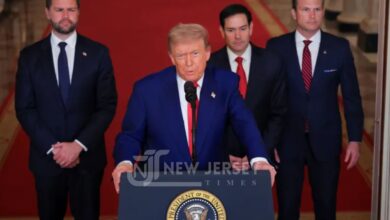
Washington, August 11 EST: Donald Trump is testing a hard-edged theory of peace in Ukraine that many of America’s allies fear would legitimize conquest. In a White House press conference, the president said ending the war will likely require “some swapping, some changes to land,” adding that he will raise territorial questions directly with Vladimir Putin at their meeting in Alaska on August 15.


It is classic Trump compress a sprawling conflict into a transactional deal, move fast, see who blinks. The trouble is that borders are not condos, and the people living behind them do not treat sovereignty like an adjustable-rate loan. According to Reuters, Trump called the session a “feel-out meeting” and insisted he could tell within minutes whether a deal is possible.
What Trump Is Signaling
The president’s message is straightforward. He believes the quickest route to a ceasefire runs through bargaining over territory, even if that means formalizing some of Russia’s battlefield gains while “getting some [land] back” for Kyiv. The pitch borrows from dealmaking rather than diplomacy.
Trump is betting that pressure, speed, and personal leverage can unlock what years of attritional warfare and multilateral talks have not. In remarks captured by Sky News, he labeled the Alaska session a “feel-out” and suggested he will know early whether Putin is serious. The open question is whether a headline ceasefire built on adjusted lines can survive first contact with politics on either side of the front.
Kyiv’s Red Line Is Law, Not Rhetoric
Volodymyr Zelenskyy responded with the kind of clarity that gives negotiators little wiggle room. Ukraine’s constitution prohibits giving away territory, and the president restated that constraint publicly. “Ukrainians will not give their land to the occupier,” he said, while warning that any decisions made without Kyiv are “dead decisions.”
TIME reported that Zelenskyy’s pushback came hours after Trump confirmed the Alaska date, underscoring the basic collision between a transactional American proposal and a Ukrainian legal and moral position shaped by invasion, mass displacement, and ongoing strikes.
Europe’s Fear: Being Cut Out And Living With The Consequences
Across Europe, leaders are telegraphing a different anxiety. They worry less about atmospherics than about precedent and security reality. If Washington and Moscow define a settlement that sidelines Kyiv, they are the ones who will live with a militarized Russia abutting the European Union for decades. Germany’s Chancellor Friedrich Merz cautioned publicly that territorial questions cannot be decided “over the heads of Europeans and Ukrainians.” It is a line about procedure, but also about power.
The Guardian reports that NATO officials are aligning behind the principle that Ukraine must be inside the room for any durable arrangement, and that a ceasefire or meaningful reduction in hostilities must frame any talks.
The Alaska Meeting’s Real Stakes
Strip away the theatrics and the Alaska meeting is a test of leverage. Russia occupies roughly a fifth of Ukraine, controls key terrain and logistics corridors, and has adapted to sanctions in uneven but real ways. Ukraine has proven it can impose costs with long-range strikes and attrit the Black Sea Fleet, yet it remains outgunned and dependent on Western support. Trump’s calculus rests on convincing Putin that the status quo is worse than a deal, and convincing Zelenskyy that a deal today is better than more blood and rubble.
The president hinted he may try to convene a follow-on session that includes Kyiv, though he cast the first meeting as bilateral. Reuters notes he even floated the possibility of a three-way meeting later, which would be a tacit acknowledgment that any paper signed without Ukraine’s assent would be politically brittle from day one.
Risks, Precedents, And The Munich Trap
If this all sounds familiar, that is because history has a way of intruding on the present. Critics see echoes of Munich 1938 in any trade of land for quiet. The analogy is imperfect, but the fear is plain: rewarding aggression now seeds more aggression later. Financial Times analysis has framed the Alaska gambit in those terms, warning that a “land-for-peace” framework risks normalizing revisionism and weakening the post-1945 norm against changing borders by force.
Even if a ceasefire holds in the near term, a settlement that locks in occupation without credible enforcement mechanisms could invite a frozen conflict that melts at Moscow’s convenience. That said, there is also a counter-history that hawks and doves both cite: every grinding European war has ended at a table, and most of those tables skirted purism in favor of stopping the killing. The hard part is designing a deal that closes doors to renewed war rather than merely pausing it.
Domestic Politics Are Not A Side Plot
This is not just a foreign policy test. It is a domestic political wager. The White House is signaling motion and control ahead of a high-visibility moment. If Trump extracts a verifiable path to a ceasefire, he will claim vindication for his instincts and argue that allies’ caution has been a brake, not a compass. If he appears to pressure Kyiv into concessions or is seen flattering Putin without extracting commitments, Democrats and a not-small cohort of Republicans will say he weakened U.S. credibility for a photo op.
The Sky News readout even noted the president’s suggestion that he can size up the deal “in the first two minutes,” which will thrill supporters who prize decisiveness and unnerve diplomats who measure progress in months, not minutes.
What To Watch Between Now And Friday
Three signals matter. First, whether the Kremlin shows any public flexibility ahead of Alaska. If Putin telegraphs rigidity, the White House may pivot to a narrower goal like a short-term ceasefire or humanitarian corridors. Second, whether Kyiv secures a clear assurance that it will be a party to any substantive talks. Without that, European support will harden behind Zelenskyy and complicate any U.S.-Russia choreography.
Third, whether European leaders translate their statements into leverage, for example by coordinating sanctions pressure or military aid in ways that raise the cost of delay. The Guardian has already reported an effort to corral leaders before Friday, precisely to avoid being presented with a fait accompli. Meanwhile, Reuters emphasizes that even Trump’s team acknowledges neither side has shown interest in ceding land, a reminder that rhetoric about swaps collides with the realities of nationalist politics and war dead.
Bottom Line
Trump is offering speed, simplicity, and personal muscle in a war defined by attrition, complexity, and collective decision-making. That mix can break stalemates or produce brittle deals. Ukraine has drawn a legal and moral line against territorial concessions. Europe is signaling it does not want its security rewritten without it. Russia has every incentive to pocket gains unless pressed hard. The Alaska meeting will not settle these contradictions, but it will reveal which side of Trump’s approach dominates in practice, the showman’s gamble or the strategist’s grind.
For now, the war is not a puzzle to be solved in minutes. It is a collision of power, law, and legitimacy that will punish any shortcut that confuses a headline for peace. According to Reuters and TIME, even the White House framing of a “feel-out” underscores that the real work would still lie ahead, in the boring, difficult mechanics of enforcement and guarantees.
New Jersey Times Is Your Source: The Latest In Politics, Entertainment, Business, Breaking News, And Other News. Please Follow Us On Facebook, Instagram, And Twitter To Receive Instantaneous Updates. Also Do Checkout Our Telegram Channel @Njtdotcom For Latest Updates.

A political science PhD who jumped the academic ship to cover real-time governance, Olivia is the East Coast's sharpest watchdog. She dissects power plays in Trenton and D.C. without bias or apology.