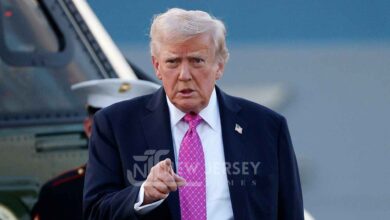
Trump Meets Starmer at Turnberry, Breaks from Netanyahu on Gaza Crisis
At a private golf resort in Scotland, the U.K. Prime Minister confronted President Trump over Gaza starvation, pushing for humanitarian aid and a ceasefire.

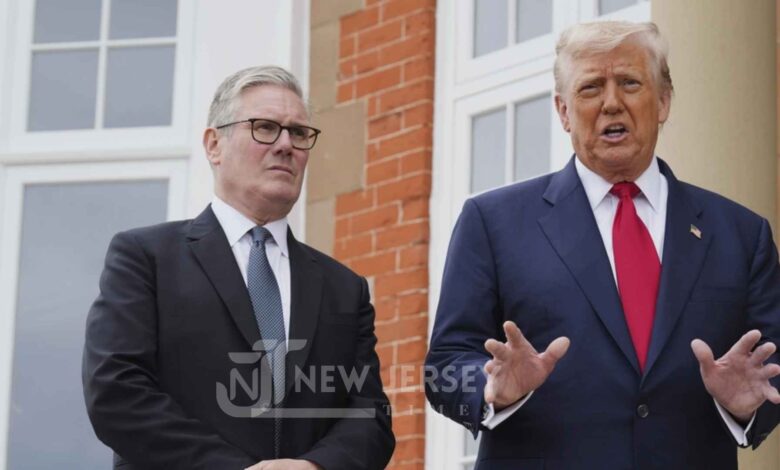
July 28 EST: The location said it all. Donald Trump, back in office, didn’t host Keir Starmer at the White House, Camp David, or even a military airbase in Europe. He summoned the British Prime Minister to his private golf resort in Scotland, a move that encapsulates Trump’s vision of power: personal, performative, and always on-brand.

A British Plea Amid a Man-Made Crisis
Starmer came with a clear ask do more for Gaza. He didn’t equivocate. He called the situation “desperate,” pressed for expanded humanitarian corridors, and asked Trump to lean harder on Israel to allow aid and consider a ceasefire. It wasn’t a dramatic gesture, but a quiet escalation a Western ally telling Washington its moral compass is out of calibration.
Historically, the U.K. follows Washington’s lead on Middle East strategy. But Starmer, in this case, flipped the script, invoking humanitarian urgency over political inertia. His move recalled moments when British leaders Harold Wilson on Vietnam, John Major in the Balkans nudged, even needled, the U.S. to see beyond military logic.
Trump’s Response: Break from Bibi, Not the Blockade
Trump didn’t push back. In fact, he broke from Benjamin Netanyahu’s line in a way few expected. “Those children look very hungry,” he said, citing media footage that contradicted Israel’s flat denial of famine conditions in Gaza. For a president notorious for echoing Israeli talking points, this was a quiet but significant swerve.
Still, Trump didn’t rebuke Israel. He spoke of constraints hostages, tunnels, terror threats as reasons for Israel’s siege tactics. His tone shifted, but the policy substance remained murky. The most concrete outcome was a promise to set up U.S.-funded food centers in Gaza, coordinated with European allies. It’s a start, but one laden with caveats and short on timelines.
When Diplomacy Becomes a Marketing Exercise
What defined the meeting, beyond Gaza or tariffs, was its theater. Trump’s insistence on hosting Starmer at Turnberry a property he’s long used to blur the line between public duty and private enterprise sparked backlash. Critics accused him of using foreign policy to boost his bottom line. Protests flared outside the resort. Diplomats winced.
This wasn’t just bad optics. It was a signal. Trump is governing as he campaigns: disruptively, transactionally, and always within reach of a camera crew. He’s betting that foreign leaders, no matter how principled, will tolerate the spectacle if they believe he holds the levers of global power.
Tariffs and Trade: No Concessions, Just Familiar Tactics
Starmer tried to use the moment to make economic headway. He raised long-standing British concerns about U.S. tariffs on steel, aluminum, and pharmaceuticals. Trump listened, nodded, and offered no concessions. His protectionist instincts haven’t softened in office; if anything, they’ve hardened. Starmer’s pitch for a more favorable trade path post-Brexit landed with a thud.
As for broader transatlantic trade? Trump brushed aside the idea of revisiting EU-wide tariffs, effectively sidelining Britain’s unique position outside the bloc. It was a reminder that in Trump’s world, bilateralism reigns but only when the other side has leverage.
Ukraine and the Clock Trump Is Running
The other item on the agenda Ukraine got little public airtime. Behind closed doors, Trump reportedly reiterated his push for accelerated peace talks, though he’s offered few specifics. His impatience with NATO’s approach is no secret, and his disdain for long-term military commitments remains a live wire in Brussels and beyond.
If there was a theme to the Turnberry summit, it was this: Trump holds court, others make their case. Starmer came to advocate for lives at risk in Gaza, to push for economic relief at home, and to reassert Britain’s voice in an increasingly chaotic global order. Trump, meanwhile, offered empathy in soundbites, aid in broad strokes, and business-as-usual in everything else.
The power dynamics were unmistakable. Starmer spoke from moral urgency. Trump responded with brand control. And in that gap between diplomacy and spectacle, the world watched children starve while a golf resort hummed with cameras and quiet deals.
New Jersey Times Is Your Source: The Latest In Politics, Entertainment, Business, Breaking News, And Other News. Please Follow Us On Facebook, Instagram, And Twitter To Receive Instantaneous Updates. Also Do Checkout Our Telegram Channel @Njtdotcom For Latest Updates.

A political science PhD who jumped the academic ship to cover real-time governance, Olivia is the East Coast's sharpest watchdog. She dissects power plays in Trenton and D.C. without bias or apology.