Hillary Clinton Targets Pete Hegseth’s “Warfighters” Rhetoric In Sharp Political Jab
The former secretary of state links martial language to political overreach, challenging the defense chief’s branding of national security.

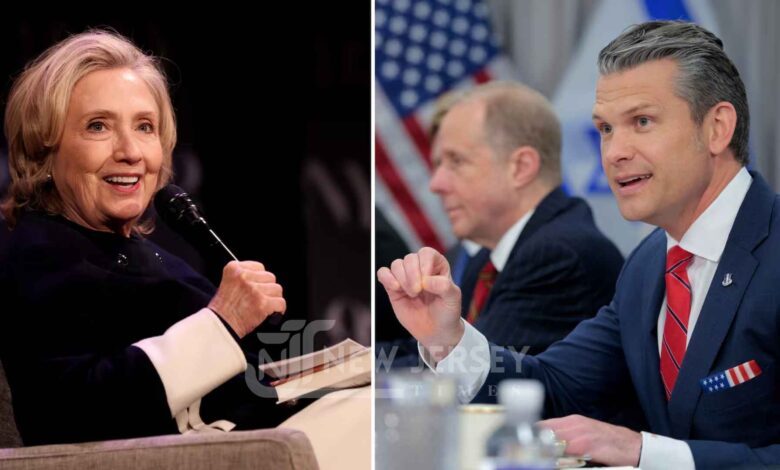
Washington, August 15 EST: Hillary Clinton did not use names. She rarely does when a nudge will do. In a brief post on X that ricocheted through political feeds, the former secretary of state mocked the familiar right-wing portrayal of American cities as no-go zones, pointing out that schoolchildren navigate Washington, D.C. and New York City every weekday.

The barb landed where it was meant to land on Defense Secretary Pete Hegseth, whose favored noun, “warfighters,” has become a rhetorical brand and a tell. According to The Daily Beast, Clinton’s timing tracked with Hegseth’s chest-forward messaging, and her critique aimed squarely at the way language is used to project strength while flattening complexity.
Her point was not simply that Republicans exaggerate urban danger. It was that the administration’s would-be toughness rests on a vocabulary that treats policy as a performance and power as posture. That said, this is hardly a new argument for Clinton, who has long believed that words create permission structures in politics. The twist is that she is now aiming at the nation’s top defense official, a seasoned media figure whose word choice is not a slip but a strategy.
Why “Warfighters” Divides Even The Military
Inside the Pentagon, the term “warfighter” is hardly exotic. It shows up in procurement docs and readiness briefings going back to the Rumsfeld years, a blunt shorthand for the pointy end of U.S. power. Still, under Hegseth, it has become something larger, almost a governing theme. He has repeatedly framed budgets, personnel, and posture through the lens of supporting “warfighters,” a stylistic tick that signals where he believes legitimacy flows from.
Critics, including veterans and defense analysts, argue the word does real work beyond branding. As reported by The Daily Beast, they see it as narrowing the definition of honorable service, sidelining the quieter professionals who make modern security possible cyber defenders, intel officers, logisticians, diplomats in uniform. The worry is not semantic hair-splitting. If you say “warfighter” often enough, you risk making combat the yardstick for value, which can distort incentives inside a sprawling bureaucracy that must deter wars, not just fight them.
Supporters counter that plain language clarifies purpose. The military exists to prevail in conflict; softer phrasing, in their view, invites soft thinking. Still, even among admirers of Hegseth’s candor, there is an unease about how easily a martial vocabulary bleeds into civilian politics, where tough talk can crowd out the patient work of coalition-building and oversight. As it turns out, words chosen at the top travel quickly down the chain.
The Crime Narrative That Will Not Die
Clinton’s aside about schoolchildren was not just a dunk. It was an evidence play. Federal data released this month show violent crime fell again in 2024, continuing the post‑pandemic retreat. According to the FBI, national violent crime dropped an estimated 4.5 percent in 2024, with murders down nearly 15 percent compared with the year prior. Those numbers complicate a familiar campaign script that paints blue-run cities as uniquely imperiled.
The politics are obvious. Crime scares mobilize voters and justify federal muscle. But the empirical story is more stubborn. Analysts note that the geography of violence rarely maps neatly onto party control at City Hall, and that many of the places with the highest homicide rates sit in red states where state-level decisions shape budgets, gun policy, and public health. Even in Washington, D.C., where the optics have been weaponized, trend lines this year have not matched the bleakest rhetoric.
Clinton’s post, then, functions as a small corrective in a bigger war over perception. It tells her audience, and Hegseth’s, that the administration’s story about urban danger is not the only story in circulation. Still, numbers do not cancel fear, and the White House understands that perception can be policy. If voters feel unsafe, they are easier to convince that force is the default setting of government.
The Power Dynamics Behind A Post
There is also the matter of status. A former secretary of state publicly ribbing a sitting secretary of defense is not routine, even in an era when the line between politics and governing is paper-thin. It signals that Hegseth’s language is not just a cultural tell but a policy lever, and that Democrats see advantage in making it a fight. Clinton, a fluent reader of Washington’s hierarchies, is reminding the town that the rhetorical frame around national security decisions can tilt the board before a memo is drafted.
Hegseth, for his part, has built a career on collapsing the gap between media combat and policy combat. He is a veteran of television and war zones, and he speaks like it, favoring declarative cadence and moral clarity. That persona is domestically potent. It rallies allies, needles critics, and reduces complex problems to clean narratives with clean villains. In a polarized environment, that is an asset. But it also creates vulnerabilities. When your brand rests on being the toughest guy in the room, opponents will test the toughness wherever your logic thins. Clinton found one of those seams and pulled.
History Rhymes, Not Repeats
The United States has periodically embraced martial language to organize politics. After 9/11, “war on terror” logic migrated everywhere, licensing shortcuts in surveillance and detention that later drew bipartisan regret. Before that, the “war on drugs” did similar damage to sentencing policy and community trust. The pattern is familiar when leaders elevate war metaphors, the policy tools on the table skew toward coercion, and oversight becomes an afterthought.
That is why the argument over “warfighters” is not a Twitter spat. It is a proxy for whether the governing vocabulary of the moment will broaden or narrow the range of acceptable solutions. If everything is combat, then dissent is disloyalty and negotiation looks like appeasement. If everything is a city-street hellscape, then civil liberties start to look like luxuries. Clinton’s post attempts to widen the frame before it locks into place.
What To Watch Next
Expect Republicans to keep leaning into urban-chaos imagery. It energizes a base that values order and signals a break with what they cast as elite complacency. Expect Democrats to counter with charts, cops standing beside mayors, and lived-counterexamples like those schoolchildren riding the subway without incident. The fight over the word “warfighters” will continue because it is legible, repeatable, and useful to both sides.
Policy will ultimately test the rhetoric. If the Department of Defense continues to prioritize “warfighter” framing in budgets and posture statements, look for congressional Democrats to press for definitions that elevate deterrence, alliances, and non-kinetic capabilities.
If the FBI’s trend lines keep pointing down, expect louder pushback when the White House invokes emergency powers or federal crackdowns in the name of public safety. For now, Clinton’s nudge reads like a warning shot to a cabinet official who understands television very well words chosen in the West Wing and the Pentagon do not just describe power, they build it. And once built, it tends to get used.
New Jersey Times Is Your Source: The Latest In Politics, Entertainment, Business, Breaking News, And Other News. Please Follow Us On Facebook, Instagram, And Twitter To Receive Instantaneous Updates. Also Do Checkout Our Telegram Channel @Njtdotcom For Latest Updates.

A political science PhD who jumped the academic ship to cover real-time governance, Olivia is the East Coast's sharpest watchdog. She dissects power plays in Trenton and D.C. without bias or apology.