
Trump’s Crime Crackdown Turns Washington Into a Federal Security Zone
National Guard patrols, federal checkpoints, and rising protests reshape daily life in the nation’s capital.

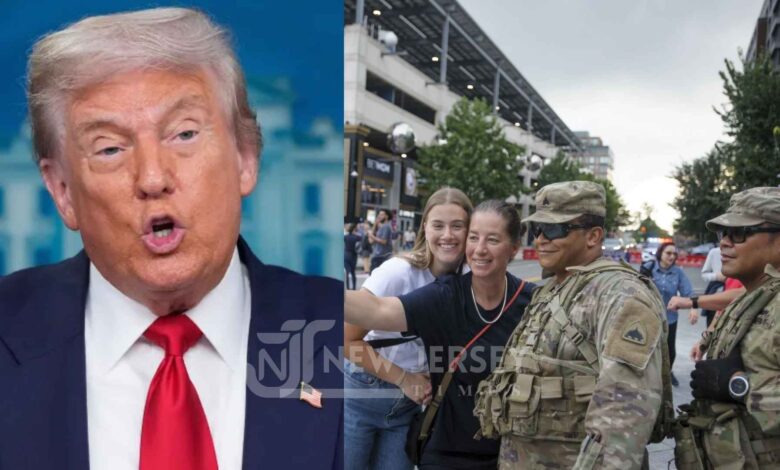
Washington, August 21 EST: The photographs tell the story more vividly than any press release could soldiers in camouflage guarding a Metro stop, federal agents in tactical gear filing out of a Northwest apartment complex, and protesters banging pots in the shadow of Union Station as the vice president arrives to shake hands with troops. President Donald Trump’s crime crackdown in Washington, D.C. is not just a policing initiative. It is a full-scale assertion of federal authority in the nation’s capital, and the optics are impossible to miss.

A Capital Under Federal Command
What began on August 8 as a multi-agency law enforcement deployment escalated three days later into something far larger. By invoking Section 740 of the D.C. Home Rule Act, Trump declared a public safety emergency, placing roughly 800 National Guard troops at his disposal. At any given time, 100 to 200 soldiers patrol alongside federal agents drawn from the FBI, U.S. Marshals, Homeland Security Investigations, and Park Police.
The result is that Washington now wears the trappings of militarization. Ordinary scenes commuters exiting a subway, families gathering near RFK Stadium, joggers circling the Mall are intersected by soldiers in body armor and armored vehicles parked at curbs. Residents describe it as a city transformed into a “security zone,” one where public space feels less like a commons and more like a checkpoint.
Also Read: Deadline Looms in Jersey City’s 2025 Mayoral Race as Field Remains Wide Open
Politics Wrapped in Uniforms
Every security deployment carries politics with it, but this one is especially deliberate. Trump has long cast Washington as a symbol of urban dysfunction and liberal mismanagement. By flooding the capital with soldiers and federal police, he is turning that narrative into a stage play the president as enforcer, the city as unruly ward of the federal state.
That point was underscored when Vice President JD Vance and Defense Secretary Pete Hegseth visited troops at Union Station earlier this week. The cameras caught them smiling with soldiers inside the terminal, while outside protesters shouted “Free D.C.” The juxtaposition was telling. Supporters see a show of strength; critics see occupation. Either way, the message was unmistakable the federal government is not just protecting Washington it is running it.
The history here is not distant. From the 1968 riots after Martin Luther King Jr.’s assassination to the 2020 George Floyd protests, the capital has been a proving ground for federal force. But unlike those moments, when unrest was acute, today’s deployment comes amid a more contested premise whether the city’s crime levels truly warrant extraordinary federal intervention. That ambiguity is what makes this operation so politically charged.
Also Read: Democrats Lose Over 2 Million Registered Voters Since 2020, Analysis Finds
D.C.’s Uneasy Place in America
For Washingtonians, this struggle cuts deeper than public safety. The city’s peculiar status taxpaying residents without statehood, governed ultimately by Congress and the White House means federal authority is always close at hand. Trump’s emergency declaration highlights just how fragile the city’s autonomy can be.
Protesters have seized on that point. Their chants and signs “No Occupation in Our City,” “Let D.C. Govern D.C.” speak not only to opposition against soldiers in the streets, but to a broader frustration with disenfranchisement. To live in Washington is to live with the constant reminder that local self-rule can be suspended at will.
Also Read: DOJ Probes D.C. Police Over Crime Data Manipulation Amid Trump Takeover
Legal Fault Lines
Beyond the politics, the law is not settled. Civil liberties advocates argue that federal agents have overstepped their authority by running traffic stops and immigration checkpoints, actions usually reserved for local police. The Associated Press reports that these tactics could invite constitutional challenges, particularly if residents are being stopped without cause.
That risk does not appear to bother the administration. Trump has framed the crackdown as a matter of restoring order and national dignity. To his allies, the images of soldiers at the Capitol and federal agents on the sidewalks send a message of control. To his opponents, they evoke something closer to authoritarian theater.
A City Waiting for Answers
What happens next is uncertain. The White House has not set a timetable for withdrawal, leaving residents to wonder whether this is a temporary surge or the beginning of a longer federal occupation. For now, the city lives in tension daily routines continue, but always under the gaze of rifles and military vehicles.
As one Georgetown resident put it bluntly this week, “It feels like we’re living in a backdrop for someone else’s political ad. We’re props in a show of power.”
That sentiment may be the most accurate reflection of the moment. Washington has always been the nation’s stage, but today its streets carry the weight of a more personal drama a city caught between being governed and being controlled.
New Jersey Times Is Your Source: The Latest In Politics, Entertainment, Business, Breaking News, And Other News. Please Follow Us On Facebook, Instagram, And Twitter To Receive Instantaneous Updates. Also Do Checkout Our Telegram Channel @Njtdotcom For Latest Updates.

A political science PhD who jumped the academic ship to cover real-time governance, Olivia is the East Coast's sharpest watchdog. She dissects power plays in Trenton and D.C. without bias or apology.