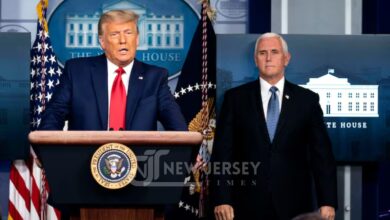
JD Vance and George Stephanopoulos’ Televised Clash Exposes Deep Divide Between Trump White House and the Press
A live interview gone off the rails captures how power, media, and political theater collide in Washington’s latest showdown.

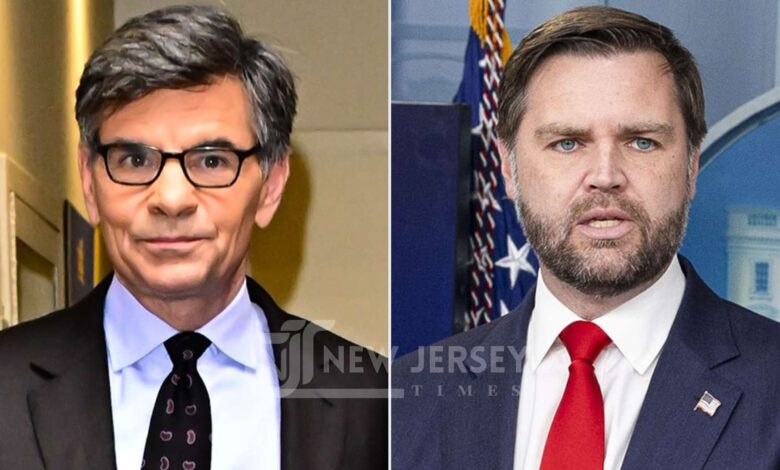
Washington, October 13 EST: The uneasy alliance between the Trump administration and the national press cracked wide open this weekend, as Vice President JD Vance live interview with ABC News anchor George Stephanopoulos devolved into a public confrontation a moment that captured, in miniature, the entire political psychology of this White House: embattled, pugilistic, and acutely aware of the cameras.

When Politics Meets Television Theater
The exchange on “This Week” was supposed to be routine a Sunday morning circuit stop for a vice president trying to project calm during a grinding 12-day government shutdown. Instead, it turned into a televised standoff. Stephanopoulos pressed Vance about alleged bribery allegations tied to former border czar Tom Homan, reportedly the target of an FBI sting. The vice president cut him off mid-question, calling it “a fake scandal,” the product of a “deeply politicized bureaucracy.”
Stephanopoulos, a veteran of Washington’s crossfire, tried to interject. Vance kept talking. Then, in a move as rare as it was telling, the anchor turned away from the guest and said, “We’ll be right back.” The network cut to commercial.
Within minutes, clips were everywhere cable panels, social feeds, right-wing podcasts each side claiming vindication. According to People.com, the abrupt cutoff wasn’t preplanned. The producers simply decided the segment had gone off the rails. But in the modern information battlefield, perception trumps production notes.
MAGA Seizes The Moment
By the afternoon, MAGA influencers had found their newest grievance. “Legacy media at its worst,” wrote Sebastian Gorka, one of Trump’s longtime defenders. The Daily Beast reported that pro-Trump groups were already circulating fundraising messages featuring stills from the segment Vance frozen mid-retort, finger raised, the chyron reading “Vice President defends administration amid scandal questions.”
Inside conservative media, the clip was instantly reframed: not a stumble, but a stand. In the populist imagination, Vance had done what Trump perfected turn the accusation itself into evidence of bias. Every interruption became proof of persecution. Every challenge, validation of their narrative that Washington’s institutions are stacked against them.
Stephanopoulos And The Ghosts Of Clinton
For Stephanopoulos, the blowback carries an old echo. Three decades after serving as a communications director in the Clinton White House, he remains an easy symbol of what the Trump-Vance movement calls “the permanent media class.” That history matters: it colors every exchange, every flash of exasperation. And as The New York Post noted, his own credibility has taken hits this year, following costly settlements tied to earlier misreporting on Trump-era investigations.
But to longtime network journalists, the confrontation was less about bias than erosion the collapse of shared boundaries between interview and argument. “You can’t interrogate someone who doesn’t recognize the premise of the question,” one former producer told Politico. “Vance isn’t trying to inform. He’s performing resistance.”
Governing In The Shadow Of The Shutdown
The interview’s fallout obscured what Vance had gone on air to discuss: a shutdown now deep into its second week, with hundreds of thousands of federal workers furloughed and no deal in sight. According to AP News, Vance warned of “deeper and more painful cuts” if Congress fails to reach agreement, language that landed like a threat more than a prediction.
For the administration, that tone is intentional. Trump governs through brinkmanship not to reach consensus, but to prove he can survive without it. Vance has absorbed that style almost perfectly. His political power comes from confrontation; his danger lies in mistaking that energy for persuasion.
Even so, the strategy is not without calculation. The White House knows that each fight with the press tightens the emotional bond with its base. As one Republican media adviser put it, “You don’t win swing voters by arguing policy on ABC. You win them by showing you’re not afraid of ABC.”
Abroad, A Softer Voice But The Same Script
Before the interview unraveled, Vance struck a markedly different tone on foreign policy. On the question of U.S. troop deployment to Gaza, he said calmly, “It is not our intention.” He praised Donald Trump’s Middle East peace deal, telling ABC’s audience that Muslims, Jews, and Christians had been “unified” under the president’s diplomatic leadership.
As The Times of India reported, Vance’s remarks were part of a broader push to portray Trump as a global peacemaker a narrative meant to offset domestic turmoil with imagery of international calm. The contrast was deliberate: statesman abroad, street fighter at home.
Still, foreign policy veterans warn against taking that rhetoric at face value. “The peace deal is fragile, and the administration is overstating its stability,” one former U.S. envoy told reporters. “They’re selling a win before it’s won.”
Testing The Boundaries Of Executive Power
Meanwhile, the administration’s domestic posture grows more combative. As The Guardian reported, Trump advisers with Vance’s explicit backing are weighing whether to invoke the Insurrection Act to deploy troops in American cities amid what they describe as rising violent crime.
The notion evokes a deep historical unease: a law last meaningfully invoked during the 1992 Los Angeles riots, now resurfacing as a political cudgel. Vance defended the consideration as “keeping all options open.” Critics see it as an authoritarian flirtation.
This is the rhythm of the Trump-Vance era provocation, outrage, consolidation. Each episode reinforces the next. Each confrontation, whether with Congress, the FBI, or a television anchor, becomes a proof of purpose.
A Mirror Of The Moment
By Monday morning, neither the White House nor ABC had issued new statements. They may not need to. The images speak louder than any press release: a vice president glaring into camera, an anchor breaking for commercial, two worlds that no longer share the same idea of truth.
For those who remember the media wars of the 1990s or the partisan rancor of the Obama years, the spectacle felt familiar but this time, the stakes are existential. The Trump-Vance administration doesn’t just distrust the press; it treats journalism itself as a political opponent. And the press, exhausted and wary, sometimes plays right into its hands.
The irony is that both sides claim to be defending democracy. One insists it’s rescuing it from corruption; the other, from demagoguery. The rest of the country is left watching the split-screen one side shouting, the other cutting to commercial wondering who, if anyone, is still listening.
New Jersey Times Is Your Source: The Latest In Politics, Entertainment, Business, Breaking News, And Other News. Please Follow Us On Facebook, Instagram, And Twitter To Receive Instantaneous Updates. Also Do Checkout Our Telegram Channel @Njtdotcom For Latest Updates.

A political science PhD who jumped the academic ship to cover real-time governance, Olivia is the East Coast's sharpest watchdog. She dissects power plays in Trenton and D.C. without bias or apology.