
Trump’s $250 Million White House Ballroom Begins with East Wing Demolition
Crews tear through the East Wing as President Trump launches a privately funded, high-profile expansion the boldest White House alteration in decades.

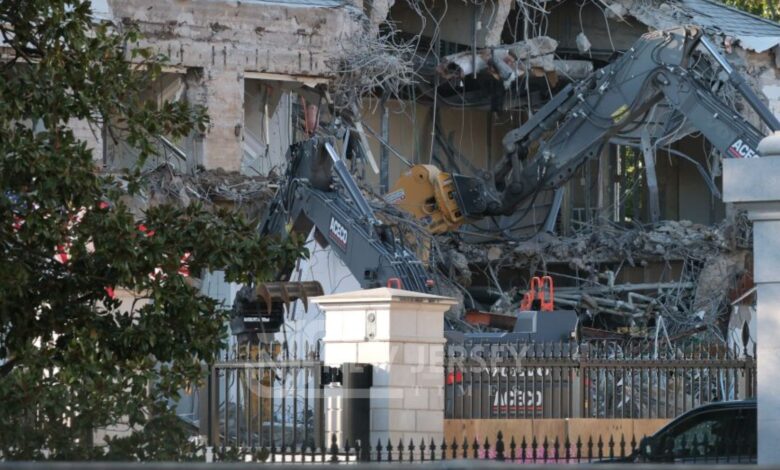
Washington, October 21 EST: The East Wing of the White House, once a stately corridor of portraits and protocol, is now a construction zone. Heavy machinery clawed through its limestone shell Monday morning, sending tremors through the South Grounds and signaling the start of President Donald Trump’s most personal project yet: a privately funded $250 million ballroom carved into the heart of the executive residence.

A New Chapter in Presidential Architecture
From the outside, it looks like another infrastructure story cranes, concrete mixers, security tape but inside the capital, this is understood as something larger: a declaration of power and permanence. For Trump, the ballroom is not just a venue. It is an imprint.
He had hinted at this dream before, back in his first term, when he mused about creating “a real ballroom, not a tent on the lawn.” Now, in his second, he’s making it real on the same footprint that Eleanor Roosevelt once used to host war briefings and where Jackie Kennedy greeted dignitaries under soft chandelier light.
“The people wanted elegance again,” Trump said at a White House event Monday, half-smiling as the rumble of bulldozers leaked into the East Room. “Every president wanted this, but I’m the one building it and it’s costing the taxpayers nothing.”
Privately Funded, Publicly Contested
The project’s financing remains its most controversial feature. The White House insists that “patriotic donors and American companies” are footing the bill, but the list of contributors has not been released. That secrecy, coupled with the sight of federal property being torn open without clear oversight, has raised hackles from both sides of the aisle.
According to The Washington Post, the National Capital Planning Commission, the body responsible for reviewing major changes to government landmarks, has not yet approved the project in full. Yet the demolition has begun.
Preservation advocates say the move risks setting a precedent allowing presidents to reshape public property with private money. “Once you cross that line, it’s hard to walk it back,” said one former federal architect, speaking to Al Jazeera. “What happens when the next president wants a new wing, or a private library inside the mansion?”
The East Wing’s Long Quiet Life
The East Wing has never drawn the spotlight like the Oval Office or State Dining Room. It’s where first ladies have traditionally kept offices, where the White House theatre sits tucked behind paneled doors, and where schoolchildren begin their tours.
Built in 1902, expanded in 1942, and largely untouched since the Truman reconstruction, it represented a kind of modesty an acknowledgment that not all parts of the presidency must perform grandeur. The new ballroom erases that restraint.
As TIME reported, the facility will cover roughly 90,000 square feet and host up to 1,000 guests, eclipsing anything the mansion has seen before. Architectural renderings show mirrored columns, a glass-domed ceiling, and marble imported from Florida quarries.
Between Spectacle and Statecraft
Trump’s allies call the project visionary. A senior aide described it as “a long-overdue upgrade that puts the White House back on the world stage.” His detractors see something closer to a personal temple Mar-a-Lago transplanted to Pennsylvania Avenue.
Both interpretations hold some truth. The president has always fused showmanship with governance, measuring political success in scale, size, and stagecraft. The ballroom fits squarely within that ethos. It will give him a dramatic setting for summits, fundraisers, and televised ceremonies a place where spectacle and diplomacy can coexist under one roof.
Displacement and Disruption
For now, though, the glamour is theoretical. The First Lady’s staff has been moved into temporary offices, and White House tours are suspended until further notice. Construction fencing now borders parts of the East Drive. Even seasoned aides admit it feels strange.
“It’s like living in a hotel being renovated around you,” one staffer told Spectrum Local News. “You can’t escape the noise.”
Press Secretary Karoline Leavitt brushed off the inconvenience, calling the demolition “a modernization project” that will leave the residence “more functional and more beautiful than ever.”
History’s Long Shadow
Every president alters the building in some way. Jefferson added the arcades, Teddy Roosevelt built the West Wing, Truman rebuilt the interior, Obama brought in solar panels. Each left a mark that reflected his time. Trump’s addition, however, feels different in kind. It’s not about safety or efficiency it’s about image.
Where Truman rebuilt to preserve, Trump builds to project. He’s turning the White House into a set piece, a stage that mirrors his sense of America as a brand in perpetual broadcast.
Historians are already debating what that means. Some call it bold, even visionary. Others see hubris in marble form. “You can measure the health of a democracy by how its leaders treat its symbols,” said one preservation scholar quoted by The Post. “Right now, that symbol is under a crane.”
What Comes Next
The administration says the ballroom will open before January 2029, though timelines for federal construction are rarely linear. Donor disclosures are pending, and the NCPC could still weigh in formally. For now, work continues floodlights on at night, jackhammers by morning.
If completed, the ballroom will be the most significant addition to the White House in living memory, a project that fuses power, vanity, and permanence in equal measure. It will also stand as a reminder that architecture is never just design it’s declaration.
The East Wing’s limestone may crumble, but the message is set in concrete: this presidency intends to be remembered not just in policy or politics, but in stone.
New Jersey Times Is Your Source: The Latest In Politics, Entertainment, Business, Breaking News, And Other News. Please Follow Us On Facebook, Instagram, And Twitter To Receive Instantaneous Updates. Also Do Checkout Our Telegram Channel @Njtdotcom For Latest Updates.

A political science PhD who jumped the academic ship to cover real-time governance, Olivia is the East Coast's sharpest watchdog. She dissects power plays in Trenton and D.C. without bias or apology.