
Trump Admits Constitution Bars Him from a Third Term
Aboard Air Force One, Donald Trump concedes the U.S. Constitution won’t allow him a third run — signaling a turning point for his political future and the Republican Party’s next chapter.


Washington, October 29 EST: For years, Donald Trump has toyed with America’s most unbreakable rule of modern democracy: two terms and out. But this week, aboard Air Force One somewhere between Washington and Seoul, he said the quiet part plainly. “If you read it,” he told reporters, “it’s pretty clear … I’m not allowed to run.”

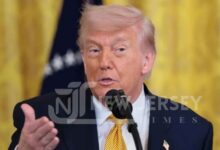
That simple sentence half resignation, half complaint amounts to the clearest public acceptance yet that the Twenty-second Amendment bars him from seeking the presidency again in 2028. For a man whose political life has been built on defiance, that’s not a small thing.
Trump Faces a Wall He Cannot Bend
Trump has spent a decade testing limits: legal, political, rhetorical. From his first campaign’s assault on establishment norms to his attempt to overturn the 2020 election, he has made a career out of seeing which guardrails would buckle. But this one will not.
The Twenty-second Amendment, ratified in 1951 after Franklin D. Roosevelt’s four elections, is one of the few constitutional boundaries the public has never seriously questioned. It was designed precisely to prevent the kind of personal rule that Trump’s more fervent followers sometimes cheer.
His acknowledgment, then, lands with quiet finality. “It’s too bad,” he said, adding that there are “a lot of great people” who could carry on the movement. To his critics, that sounded like closure. To his allies, it sounded like strategy.
The Political Subtext: Control the Succession
In truth, Trump’s words do not signal retreat. They signal consolidation. By publicly conceding he cannot run again, Trump effectively crowns himself kingmaker of the Republican Party’s next generation a patriarch rather than a candidate.
As House Speaker Mike Johnson told reporters, “there is no path” to amending the Constitution in time for another Trump run. But that doesn’t mean Trump’s influence evaporates. Far from it. His endorsement remains the most valuable and perilous asset in GOP politics.
Republicans close to Trump have already begun sketching what a “post-Trump” party still under Trump’s shadow might look like. “He’ll pick his successor,” one campaign strategist said this week. “And if history is any guide, that person will live and die by his approval.”
Historical Echoes: When Power Meets Its Limits
American presidents have rarely faced this kind of self-imposed wall in public view. Ronald Reagan left office adored but bound by the same rule. Bill Clinton flirted with irrelevance before reinventing himself as a global envoy. Barack Obama turned his post-presidency into an institution of its own.
Trump, characteristically, has shown no interest in quiet elder statesmanship. His movement was never about governing alone it was about loyalty, spectacle, and dominance. The term limit doesn’t end those instincts; it only redirects them.
Constitutional scholars like Jessica Levinson of Loyola Law School told AP News the moment represents “a rare point of constitutional clarity” in Trump’s tumultuous relationship with the law. “There’s no ambiguity here,” she said. “The framers of the amendment intended to stop any president popular or not from seeking a third term.”
That may be why Trump’s tone this week was tinged with frustration rather than surprise. For a man accustomed to bending systems to his will, running up against something immovable must sting.
The GOP’s Silent Scramble
Inside Republican circles, Trump’s statement has forced an awkward reckoning. The fantasy of a third Trump campaign often winked at in fundraising emails and on merchandise was, for some, a way to keep donors and voters engaged. Now, with the former president admitting the door is closed, attention is shifting fast.
Names like Ron DeSantis, J.D. Vance, and Nikki Haley are being whispered again in donor suites and Capitol hallways. Each faces the same paradox: how to inherit Trump’s movement without inheriting his liabilities.
Some in the party see Trump’s acknowledgment as a political clean slate. Others worry it only deepens his hold. “He’ll still be on the ballot,” said one Republican strategist. “Not his name, but his shadow.”
Beyond the Ballot: Power by Proxy
Trump’s influence has never been confined to the office itself. Even outside power, he commands attention through rallies, social media posts, and the constant hum of grievance politics. Admitting he can’t run again may free him to wield that influence unburdened by campaign mechanics an unaccountable force in the primary process.
That prospect unnerves even some of his admirers. “The most dangerous man in politics,” one conservative columnist noted, “is the one who has nothing left to win.”
Whether Trump uses his freedom to build up a successor or burn down rivals remains an open question. His political history suggests he’ll do a bit of both.
The Constitutional Line That Still Holds
In an era when institutions bend under partisanship, the Twenty-second Amendment stands as one of the last undisputed lines in American political life. Talk of repealing it surfaces occasionally in the fever swamps of online fandom, but the arithmetic of amendment two-thirds of Congress, three-quarters of the states makes it a practical impossibility.
Speaker Johnson, one of Trump’s most loyal allies, put it bluntly this week: “It would take years.” Even in a Republican-dominated government, few lawmakers are eager to be seen dismantling a cornerstone of the modern presidency.
So for now, the barrier holds. Trump seems to know it. And in his rare moment of candor, he may have given the country something unusual: a moment where constitutional law, not political will, had the final word.
A Movement in Search of Its Future
Trump’s acceptance of the term limit does not mean the Trump era is over. It simply enters a new phase one defined less by electioneering than by influence. In American politics, formal power and real power have never perfectly aligned, and Trump understands that better than most.
“It’s too bad,” he said, with the faint tone of a man who knows he won’t stop talking about the thing he can’t have.
But history is full of such momentsleaders who learn that the state, for all its flaws, still has the power to say no. For all the tumult Trump has unleashed, this week he met a limit that even he could not spin away.
And for the first time in years, the Constitution won the headline.
New Jersey Times Is Your Source: The Latest In Politics, Entertainment, Business, Breaking News, And Other News. Please Follow Us On Facebook, Instagram, And Twitter To Receive Instantaneous Updates. Also Do Checkout Our Telegram Channel @Njtdotcom For Latest Updates.

A political science PhD who jumped the academic ship to cover real-time governance, Olivia is the East Coast's sharpest watchdog. She dissects power plays in Trenton and D.C. without bias or apology.