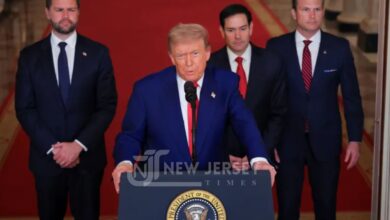
Trump Rejects 2028 VP Run but Keeps Third-Term Ambitions Alive
On Air Force One, the president brushed off a vice-presidential bid as “too cute,” while hinting that his influence and perhaps his ambitions are far from over.

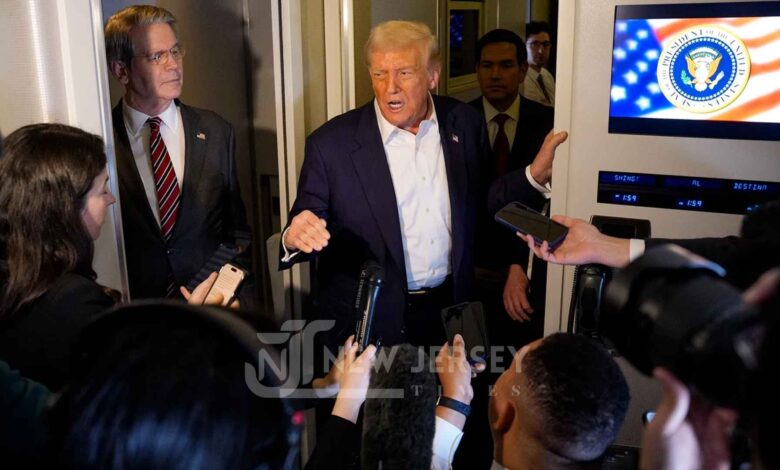
Washington, October 27 EST: On board Air Force One Monday afternoon, President Donald Trump shot down one of the more inventive schemes his allies have floated to extend his grip on power. Asked whether he might run as Vice President in 2028 a constitutional gray zone some supporters have whispered about Trump waved it off. “I’d be allowed to do that,” he told reporters. “But I wouldn’t do that. I think it’s too cute.”


With that single remark, the sitting president closed one backdoor while quietly leaving another one ajar. He ruled out a vice-presidential run, yes but he pointedly did not rule out running for president again in 2028, a prospect that would collide directly with the 22nd Amendment’s two-term limit.
It was classic Trump: disarm the rumor, stoke the myth, and keep the spotlight fixed exactly where he wants it.
The Constitutional Gamesmanship
Trump’s comments, reported by Reuters, slice through weeks of quiet speculation that his loyalists had been testing out loud. The theory equal parts legal experiment and political fantasy went something like this: if Trump joined a ticket led by a loyal successor such as J.D. Vance or Marco Rubio, and that president later stepped aside, Trump could resume office. The Constitution, after all, forbids a person from being elected president more than twice, but says nothing explicitly about serving again through succession.
It’s the kind of constitutional hair-splitting that scholars tend to swat down quickly, but it thrives in Trumpworld because it keeps the movement’s totem alive. According to The Guardian, Trump’s allies view such musings not as legal strategy but as a loyalty test a way to measure who’s still willing to bend the rules of power in his name.
By calling the idea “too cute,” Trump effectively dismissed the gambit as beneath him but not because it’s unconstitutional. It was a question of optics, not law. As he put it: “People wouldn’t like that.”
The Long Shadow of the 22nd Amendment
Since its ratification in 1951, the 22nd Amendment has been a blunt guardrail a reaction to Franklin D. Roosevelt’s four-term presidency and the anxieties of permanent incumbency. But Trump has never been bound by political taboos. He has long tested the norms that most presidents treat as sacred the peaceful transfer of power, the separation between campaign and state, even the legitimacy of elections themselves.
That’s what makes his latest remarks more than idle chatter. They signal how Trump intends to manage his own political afterlife: as a figure both indispensable and uncontained by the usual rules. “We have the best numbers ever,” he boasted during the exchange, according to El País, underscoring that the presidency for him has always been less about office than about dominance.
A Movement, Not a Term Limit
Inside the Republican Party, Trump’s statement will land with dual meaning. On the surface, it’s a gesture of restraint a president seemingly acknowledging the limits of power. But beneath that, it’s also a reassertion of hierarchy. By ruling out the vice-presidency but praising Vance and Rubio as “great people” who could form an “unstoppable group,” Trump cast himself as both kingmaker and gatekeeper of 2028.
The calculation is shrewd. Declining the VP route avoids a constitutional quagmire that would alienate moderates, while still cementing Trump’s position atop the Republican succession pyramid. His public endorsement of potential heirs isn’t generosity; it’s insurance.
The pattern is familiar in American politics, though rarely so overt. Ronald Reagan once elevated George H. W. Bush as a successor to consolidate the conservative movement; Barack Obama did something similar with Joe Biden, ensuring continuity of brand if not ideology. Trump, however, plays it differently he elevates allies to extend himself. Every name he mentions becomes a proxy, not a successor.
The Sound of Silence in the GOP
So far, neither Vance nor Rubio has commented on the president’s remarks. Party leadership, too, is staying quiet. For them, the moment is delicate. To echo Trump’s openness about 2028 risks looking disloyal to the Constitution; to challenge it risks being exiled from his orbit.
According to strategists close to the White House, the silence isn’t indecision it’s calculation. “No one wants to look like they’re auditioning while the boss is still in office,” said one veteran Republican operative. “But everyone’s thinking about it.”
Trump’s dominance of the GOP is such that even his hypotheticals become policy debates. His casual musing about “another run” instantly becomes a stress test for the party’s future who flinches, who follows, who dares to imagine a post-Trump world.
Beyond the Loophole
Legal scholars, meanwhile, have been quick to reassert that the 22nd and 12th Amendments together make any vice-presidential route untenable. “It’s a dead end,” one constitutional lawyer told ABC News, noting that a two-term president is “ineligible for the presidency, and therefore ineligible for the vice-presidency.”
But the legalities may be beside the point. For Trump, the question isn’t can he serve again it’s will he still matter when he can’t. The answer, judging by his rhetoric, is an emphatic yes. The movement he built remains more cohesive and more dependent on him than any in modern Republican history.
What Comes Next
Trump’s rejection of the 2028 vice-presidential scenario resets the conversation but doesn’t end it. His continued ambiguity about a third term ensures that political oxygen will keep flowing toward him long after the Constitution closes its door.
Behind the scenes, aides are already positioning 2028 as a test of loyalty rather than ideology. A Vance–Rubio ticket, should it ever form, would likely be pitched not as a departure from Trumpism, but as its next iteration a new face for the same project.
That’s the enduring lesson of Trump’s politics: the rules matter less than the narrative. When he says something is “too cute,” what he really means is that it doesn’t serve his myth. And myths, unlike presidencies, have no term limits.
New Jersey Times Is Your Source: The Latest In Politics, Entertainment, Business, Breaking News, And Other News. Please Follow Us On Facebook, Instagram, And Twitter To Receive Instantaneous Updates. Also Do Checkout Our Telegram Channel @Njtdotcom For Latest Updates.

A political science PhD who jumped the academic ship to cover real-time governance, Olivia is the East Coast's sharpest watchdog. She dissects power plays in Trenton and D.C. without bias or apology.