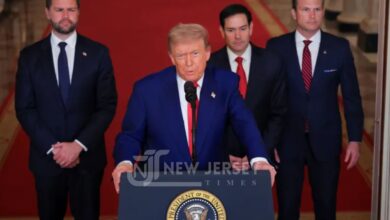
Karoline Leavitt’s Combative Briefing Puts Trump’s Gaza and Ukraine Policies in Sharp Relief
The White House signals pressure on Israel for a Gaza ceasefire while drawing a hard line against U.S. troop deployment in Ukraine.

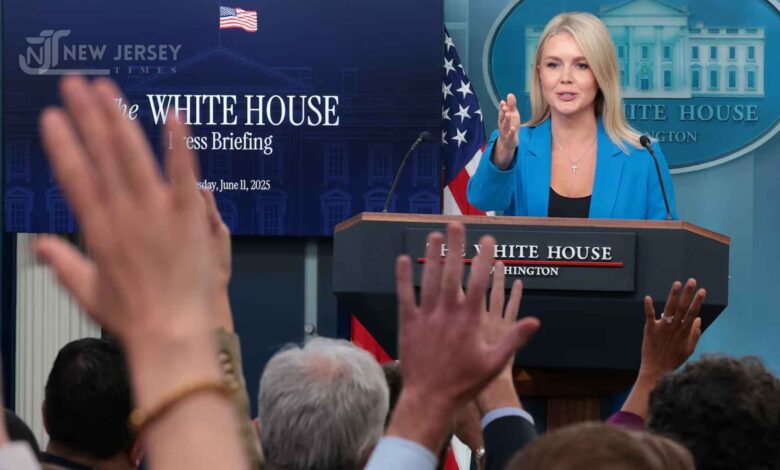
Washington, August 19 EST: Karoline Leavitt used the White House podium this week the way power players have used it for decades to project leverage abroad and control the tempo at home. In a brisk briefing, the press secretary said the United States is discussing a new 60-day ceasefire in Gaza, a proposal she said Hamas has accepted and that now awaits Israel’s response. She also reiterated that U.S. troops will not deploy to Ukraine, framing President Donald Trump’s approach as heavy on coordination, light on entanglement. According to Reuters and AP News, those two strands define the moment diplomacy by pressure in the Middle East, restraint by design in Eastern Europe.

Gaza Talks Enter A Volatile Window
Leavitt’s disclosure about a potential Gaza truce sounded simple. It is not. A 60-day halt, if it holds, would be the longest breathing space since the conflict reignited, and could reshape humanitarian access, hostage negotiations, and battlefield calculus. According to Reuters, Hamas has signaled acceptance. That leaves Israel with the next move, and that is where the politics grow harder. Israeli war cabinets do not make decisions in a vacuum; they move with one eye on security imperatives and another on domestic legitimacy. If the terms are read inside Israel as constraining the military too tightly or rewarding Hamas prematurely, the deal could stall on its own runway.
Leavitt offered a telling aside, suggesting that timing may have been influenced by a forceful Truth Social post from Trump. That remark reveals the theory of the case inside this White House public pressure is part of the negotiating toolkit. The approach nods to the administration’s earlier posture during the Abraham Accords, when public ceremony and private bargaining worked in tandem. Still, Gaza is not the Gulf. The Israeli political class is more fragmented, Hamas has different incentives than states that normalized ties with Israel, and the battlefield remains fluid. A truce is a tactic, not a settlement. The risk is obvious. When Washington elevates public brinkmanship, it gains short-term leverage but can narrow room for quiet compromise.
Trump’s Public Pressure Campaign
Presidents have often used public rhetoric to bend talks. Ronald Reagan applied it to arms control. Bill Clinton deployed it at Camp David. Trump operates in that lineage, but with a social media megaphone that collapses distance between tactical posturing and presidential decree. That immediacy can energize allies who want movement and rattle counterparts who fear missing a window. It can also harden positions. Leavitt’s suggestion that a presidential post nudged Hamas highlights a paradox boasting about influence can create incentives for the other side to prove autonomy the next time around.
For now, the measurement is simple. If Israel engages on the 60-day plan, Washington will claim credit for momentum. If not, the administration will frame rejection as proof that it tried, and pressure will shift back to Jerusalem. As reported by Reuters, the United States is still in the room, which is often the most decisive fact in complex talks.
Ukraine Lines Redrawn Without Troops
On Ukraine, Leavitt drew a firm line no U.S. troops in the fight. AP News reports that Trump emphasized security coordination and guarantees instead, while continuing to cast himself as a leader who can broker direct diplomacy between Volodymyr Zelenskyy and Vladimir Putin. That is classic Trump-era positioning. The White House signals toughness through economic, logistical, and political instruments, while rejecting open-ended military commitments that have defined earlier periods of U.S. power.
That said, restraint is not the same as retreat. The administration is trying to preserve influence in Kyiv without crossing thresholds that would force a broader confrontation with Moscow. Critics will argue, as they have since 2014, that adversaries understand strength in terms of hard power, not messages of caution. Supporters will counter that keeping U.S. troops out of a direct conflict while sustaining Ukraine’s ability to resist is not timidity but prudence. Both views can be true at different times. The test is whether the security guarantees Washington is exploring carry enough weight to shape Russia’s choices and Ukraine’s risks.
History is a useful guide here. Barack Obama balanced sanctions and limited military aid in 2014, then expanded assistance without committing U.S. troops. Joe Biden scaled up lethal aid and diplomatic coalition-building. Trump is carving a third path that stresses negotiated outcomes and American distance from the front line. According to AP News, his public insistence on no U.S. boots is meant to settle nerves at home and set expectations abroad. It also locks the White House into a narrower set of tools, which means every tool must be used precisely.
A Press Shop Built For Combat
Leavitt’s performance is not just policy messaging. It is political choreography. AP News documented her debut on January 28, 2025, noting she is the youngest-ever to hold the job. The style has been more bulldog than bridge-builder. On June 11, as reported by The Daily Beast, she abruptly ended a briefing after bristling at questions on free speech and potential force against protesters tied to a planned military parade. That exit was not a one-off gaffe. It signaled a press operation calibrated for confrontation, which plays well with a base that views the press as an adversary and sees aggressive sparring as proof of backbone.
There is a tradeoff. Combativeness can keep the story tight and the message disciplined. It can also erode trust with reporters who sit on the other end of the information pipeline that the White House still needs in moments of ambiguity. Past administrations learned that lesson the slow way. The Obama team started cool and press-shy, then built relationships to sell complex policies. The Trump operation seems content to ride the friction. If policy breakthroughs arrive, the approach will be cast as bracing clarity. If they do not, the friction will look self-defeating.
The Power Dynamics Beneath The Briefing
Strip away the theatrics and the fundamentals are clear. Washington wants a ceasefire in Gaza that lowers temperature and opens space for humanitarian relief and further talks. It also wants to keep Ukraine viable without crossing the threshold of direct war with Russia. Both objectives rely on influence rather than force. Influence requires credibility. That is where Leavitt’s podium matters. When the White House says Hamas has accepted terms and that Israel is considering them, it is staking claim to stewardship of a delicate process. When it says no troops to Ukraine, it is asserting the contours of U.S. power the rest of the world must now factor into their plans.
Still, diplomacy is not a straight line. Israel’s internal politics can upend the truce in a single cabinet meeting. Russia can test Western resolve with a winter offensive. Ukraine can press for more than coordination. The administration’s bet is that controlled pressure and careful distance will produce gains without new quagmires. That bet is cleaner on paper than in practice.
What To Watch Next
The immediate markers are concrete. Does Israel formalize a response to the 60-day Gaza ceasefire and on what terms. Do U.S. officials convert talk of security guarantees for Ukraine into mechanisms that deter Russia and reassure Kyiv. And does the Leavitt-led press operation show any appetite for a less combative posture as negotiations tighten and public signaling becomes riskier.
For now, the White House is moving on two fronts with the same instinct apply public pressure, avoid military escalation, and keep control of the narrative. That mix can succeed if the other players believe the United States can deliver. It can fail if they decide the podium speaks louder than the policy.
New Jersey Times Is Your Source: The Latest In Politics, Entertainment, Business, Breaking News, And Other News. Please Follow Us On Facebook, Instagram, And Twitter To Receive Instantaneous Updates. Also Do Checkout Our Telegram Channel @Njtdotcom For Latest Updates.

A political science PhD who jumped the academic ship to cover real-time governance, Olivia is the East Coast's sharpest watchdog. She dissects power plays in Trenton and D.C. without bias or apology.