Barack Obama Warns U.S. at “Inflection Point” After Political Violence
Former President criticizes Trump-era division, reacts to Jimmy Kimmel’s suspension, and addresses protester on Israel-Palestine debate.

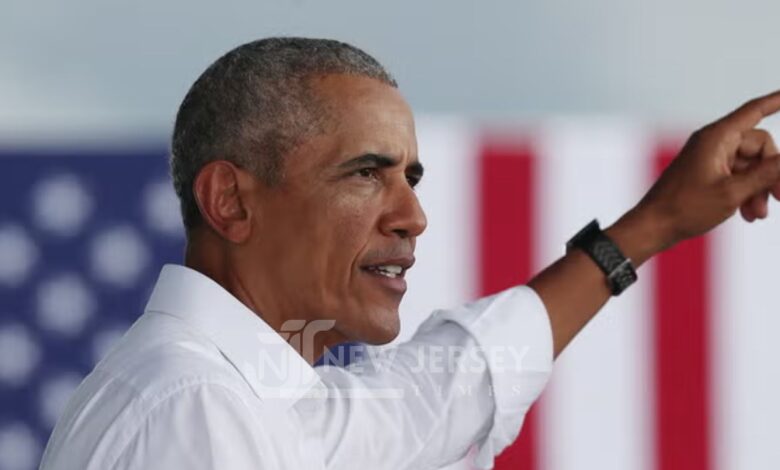
Erie, September 18 EST: Barack Obama is no longer president, but in Pennsylvania this week he spoke with the urgency of someone who still feels the weight of the office. His warning was blunt: America is at “an inflection point,” and the question is whether the country can still hold together when its political bloodstream is poisoned by polarization.

A Tragedy Turned Into Ammunition
The death of conservative activist Charlie Kirk should have been a moment for grieving. Instead, it has become another battlefield in America’s endless partisan war. Obama, addressing the crowd in Erie, did not mince words about how the tragedy has been seized upon. “This should have been a moment of shared mourning,” he said. “Instead, it’s being twisted in ways that drive people further apart.”
What he left unsaid, but was unmistakable to the audience, was that Donald Trump and his allies have already folded Kirk’s killing into a narrative of victimhood and blame, casting the right as martyrs under siege. This is not new. American politics has a long history of tragedy being repurposed for partisan gain. But in today’s environment, the speed and intensity of that transformation feels different.
Obama was trying to remind the country that democracy only works when people resist the reflex to turn every wound into a weapon. The irony is that in Trump’s America, wounds have become currency.
The Battle Over Speech
If Kirk’s killing highlights the exploitation of grief, the suspension of Jimmy Kimmel underscores the exploitation of power. Under Trump’s second administration, cultural skirmishes have been repurposed into levers of state control.
Obama, who has been cautious in his post-presidency about entering the daily churn, sounded alarmed about the direction of free expression. According to Business Insider, he argued that Trump officials are “taking cancel culture to a new and dangerous level” by directly leaning on networks to sideline dissenting voices. His point was clear: this is not about a late-night host’s crude jokes or partisan barbs. It is about the precedent of a president using the machinery of government to dictate who gets a platform.
For context, Americans have always lived with pressure campaigns, from boycotts in the Civil Rights era to conservative crusades against Hollywood in the 1990s. But the state’s hand rarely pressed down so visibly on the scale. What Obama fears, and what legal scholars have echoed for months, is that this is not just politics. It is the slow normalization of censorship dressed up as accountability.
“Today it’s Kimmel,” Obama said. “Tomorrow it could be someone whose politics you agree with.” The audience understood the subtext: liberties rarely vanish overnight. They wither by precedent.
The Israel-Palestine Flashpoint
The Erie event also revealed how easily America’s deepest divides spill into any forum. When a man in the audience interrupted Obama with pro-Palestinian slogans, the former president bristled: “Sir, I am not the President. So there’s no point shouting at me.”
That sharpness was uncharacteristic of Obama’s cool public style, but it carried a second layer of meaning. His presidency was often defined by tightrope-walking on Middle East policy, and he knows better than most how impossible it is to please all sides. Still, he pivoted the interruption into a larger reflection on what he sees as the core danger of American discourse today: the loss of empathy.
“When you start seeing people as symbols instead of human beings,” he said, “you stop listening. And when you stop listening, terrible things follow.”
It was a small exchange, but it landed. In an era when debates over Gaza and Israel have cleaved campuses, communities, and even families, Obama was reminding the crowd that arguments about foreign conflicts are also tests of domestic civility.
The Stakes In Erie
Obama did not pick Erie at random. This is one of those working-class counties that flipped from him to Trump, a political weathervane in miniature. The former president, now an elder statesman rather than a candidate, is testing whether moral authority still carries weight in the very places that delivered his successor back into power.
And here lies the crux of his warning. American politics has always been rough, often cruel. But what troubles Obama is the sense that tragedy, censorship, and even foreign conflicts are now all absorbed into the bloodstream of domestic polarization. Nothing exists outside the partisan frame.
When Obama says the country is at an inflection point, he is drawing on history: the Civil War, the Depression, the civil rights movement. Each was a moment when the fabric could have torn but instead was rewoven. His argument is that today’s test is not material but psychological. Can Americans still see one another as citizens rather than combatants? Or has Trumpism redefined politics into a permanent state of siege?
A Voice From The Past, Speaking To The Future
The Obama who spoke in Erie was not the cautious incrementalist of his presidency. He was blunt, even angry at times, as though freed by the fact that he no longer has to run for anything. That freedom gives his words power, but also limits them. Elder statesmen can warn, but they cannot govern.
Still, his message was unmistakable: America is burning energy not on solving problems but on feeding division. And unless that cycle breaks, Kirk’s death will not be the last tragedy to be swallowed whole by the partisan machine.
Obama ended by posing the question that has haunted every republic on the edge of fracture: “Do we still have the capacity to see our neighbors as fellow citizens?” It was not rhetorical. In Erie, the answer felt very much in doubt.
New Jersey Times Is Your Source: The Latest In Politics, Entertainment, Business, Breaking News, And Other News. Please Follow Us On Facebook, Instagram, And Twitter To Receive Instantaneous Updates. Also Do Checkout Our Telegram Channel @Njtdotcom For Latest Updates.

A political science PhD who jumped the academic ship to cover real-time governance, Olivia is the East Coast's sharpest watchdog. She dissects power plays in Trenton and D.C. without bias or apology.