

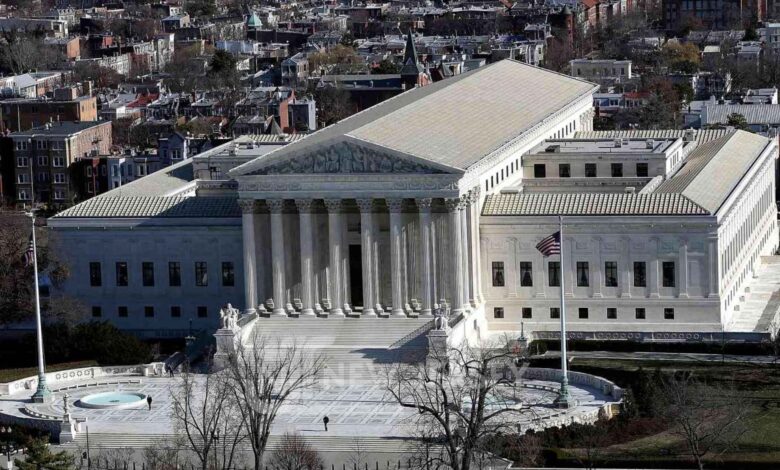
Washington, July 8 EST: The Supreme Court on Monday gave President Donald Trump a green light to proceed with the most sweeping purge of the federal workforce since the Pendleton Civil Service Reform Act of 1883. The unsigned order didn’t just lift a procedural freeze—it effectively invited the executive branch to begin dismantling key functions of the modern administrative state while courts sort out the legal mess later.

The Court’s Signal: Deference Over Disruption
The ruling, which vacates a lower court’s injunction against Trump’s February executive order, allows agencies to restart layoffs and reorganization plans that could displace tens of thousands of federal workers. The majority offered no full reasoning but did tip its hand: the administration, they wrote, is “likely to succeed” on the merits.
Translation? The Court, now firmly anchored on the right, appears increasingly comfortable with expanding presidential control over the civil service—even in ways that upend longstanding norms of bureaucratic independence.
It’s the kind of judicial posture that echoes the Lochner-era Court—less concerned with the practical consequences of governance, more fixated on a reassertion of formal power lines.
Jackson’s Dissent: A Solitary Warning
Justice Ketanji Brown Jackson, the lone dissenter, didn’t mince words. Calling the executive order a “wrecking ball,” she warned the ruling would hollow out essential public services and dangerously aggrandize presidential authority. Her dissent was not just legal but institutional—a plea to preserve the professional backbone of government from political demolition.
“Emergency dockets,” she noted, are for emergencies—not for rubber-stamping sweeping policy shifts with generational impact. But with the conservative majority dismissing that concern, Jackson found herself once again playing the long game: writing for history more than the moment.
Which Agencies, Which Jobs
The layoffs—some already in motion under voluntary “deferred resignation” programs—target nearly every major federal department: Health and Human Services (CDC, FDA), EPA, Veterans Affairs, Agriculture, State, and Social Security, among others.
The administration insists it’s trimming “bloated bureaucracy.” Critics, including a raft of unions and local governments suing to stop the cuts, say it’s a calculated strike on federal expertise—particularly in areas like science, public health, environmental regulation, and international diplomacy.
At least 75,000 federal employees have already signed exit agreements under pressure. Internal memos cited by The Washington Post suggest that number could more than double by year’s end if mass Reduction-in-Force (RIF) notices proceed as planned.
The Strategy Behind the Shock
This isn’t just about layoffs. It’s about restructuring the federal government to reflect Trump’s vision of a lean, obedient executive—unconstrained by professional civil servants he’s long derided as “the deep state.”
Central to that project is the revival of Schedule F, a Trump-era personnel classification that strips employment protections from thousands of policy-level staffers. That move, blocked under President Biden, is now being resurrected with more aggressive intent.
Critics see a slow-motion loyalty purge, one that recasts public service into political service. The policy’s defenders say it merely restores accountability and responsiveness.
Either way, the implications are seismic: civil service protections—once seen as foundational to neutral, competent governance—are now just another front in the war over presidential power.
What Happens Next
From here, the litigation grinds on. U.S. District Judge Susan Illston, a Clinton appointee in Northern California, will resume hearings on the case brought by federal unions and public interest groups. Her initial injunction argued that Trump’s order likely violated existing civil service statutes.
But with the Supreme Court lifting that stay, Illston now faces a judiciary signaling it may not back her even if she finds the order unlawful.
There’s also the broader legal trend to consider: the Roberts Court is actively narrowing the power of lower courts to issue nationwide injunctions. That shift, while procedural on paper, tilts the chessboard in favor of future administrations seeking to enact sweeping changes without waiting for full judicial review.
A Test of Institutional Memory
It’s not the first time Washington has seen the civil service under siege. President Andrew Jackson famously initiated the “spoils system,” purging government jobs to reward loyalists. A century later, the Hatch Act and Pendleton reforms sought to insulate government work from raw political interference.
Trump’s latest push doesn’t just roll back those norms—it’s attempting to erase them entirely.
If successful, the result could be a government remade in a single president’s image, where loyalty outranks expertise, and where public policy is increasingly dictated by ideological allegiance rather than institutional wisdom.
That may excite supporters craving “deep state” revenge. But for the country’s 2 million civil servants—and the Americans they serve—the real test will be whether anyone’s left to keep the lights on in Washington when the political winds shift.
New Jersey Times Is Your Source: The Latest In Politics, Entertainment, Business, Breaking News, And Other News. Please Follow Us On Facebook, Instagram, And Twitter To Receive Instantaneous Updates. Also Do Checkout Our Telegram Channel @Njtdotcom For Latest Updates.

A political science PhD who jumped the academic ship to cover real-time governance, Olivia is the East Coast's sharpest watchdog. She dissects power plays in Trenton and D.C. without bias or apology.




