
Olivier Rioux’s Towering Debut: Florida’s 7-Foot-9 Freshman Makes NCAA History
The tallest college basketball player ever finally stepped onto the court — and in just two minutes, turned a routine blowout into a moment of sports history.

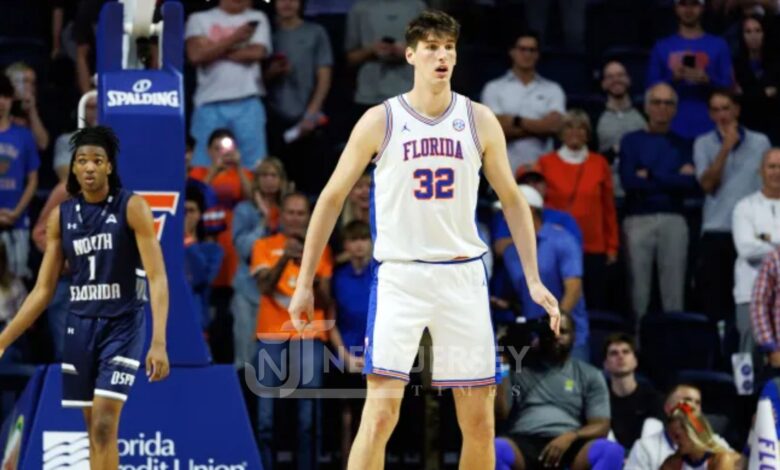
Gainesville, November 7 EST: Sometimes a basketball game stops being about the score and becomes something else entirely. That’s what happened inside the O’Connell Center Thursday night, when the crowd rose to its feet, phones in the air, chanting one name that echoed through the rafters: “We want Ollie.” And finally, with 2:09 left in the Florida Gators’ 104–64 demolition of North Florida, Coach Todd Golden gave in. He pointed down the bench, and out stepped a kid who looked like he’d been plucked from another dimension. Olivier Rioux 19 years old, 7 feet 9 inches tall, the tallest college basketball player ever checked into a real NCAA game for the very first time.


The Moment The Arena Held Its Breath
The ball didn’t find him. He didn’t block a shot. He didn’t score. Didn’t need to. When you’re 7-foot-9, just walking onto the hardwood is enough to change the gravity of the building. Fans went wild. Teammates stood grinning like kids who’d just watched a Disney ending unfold.
It wasn’t a stat-sheet debut. It was something purer. A standing ovation for persistence, for possibility, for the long road of a teenager who’s been stared at his entire life and still keeps showing up to play.
As CBS Sports pointed out, no one taller has ever set foot in a college basketball game. Olivier Rioux now owns that record and the story that goes with it.
A Giant With Patience
He’s been measured, marveled at, and memed since middle school. A Guinness World Record holder as the world’s tallest teenager, Rioux was more headline than highlight for years. But the kid from Montreal didn’t let it become a sideshow. He put in the hours at IMG Academy in Bradenton, surrounded by elite athletes who could dunk before they could drive.
He could already dunk standing flat-footed. The trick wasn’t reaching the rim it was learning how to move with purpose, to run without pain, to make that height an advantage instead of a burden.
“It felt great,” Olivier Rioux told People afterward. “The support from everybody was amazing, even on the bench and even the fans. I think everybody supported me. I’m very grateful.”
That gratitude showed. He ran the floor hard, stayed alert, and never tried to force a play. You could see the nerves in his first steps part awe, part relief.
More Than A Curiosity
Let’s be honest: when a 7-foot-9 guy walks into a basketball game, people gawk. But that’s not where this story ends. The New York Post nailed it this wasn’t a novelty cameo. Golden didn’t send Olivier Rioux in as a gimmick; he sent him in because he’d earned it. The chants might’ve sped things up, but the kid’s been grinding through drills, conditioning, and all the unseen hours between the lights.
“It’s really neat for him to finally see the floor,” Golden said after the game. “I would have liked to see him get a touch. But it’ll happen for him.”
A Team That Believed
The Gators, fresh off their national championship season, didn’t need another storyline. But sports don’t work that way. Every now and then, a program gets a human story that transcends the bracket. Olivier Rioux debut was one of those moments part feel-good headline, part living reminder of what makes college basketball so magnetic.
The best part? The crowd wasn’t mocking him. They were with him. Those chants of “We want Ollie” weren’t jeers they were an invitation. The O’Dome crowd wanted him to have that moment, and when he got it, they treated it like a victory.
What 7-Foot-9 Really Means
Here’s the thing about being that tall: it’s not easy. Every step, every jump, every practice comes with strain most athletes can’t imagine. Guys built like Olivier Rioux fight physics as much as opponents. Manute Bol and Gheorghe Muresan knew it too the body isn’t always designed to handle that scale.
So for Olivier Riou, success won’t be measured in points. It’ll be in minutes logged, practices finished, nights without pain. As The Times of India put it, his height is “an asset and a responsibility.”
That’s why Thursday night mattered. It wasn’t about spectacle. It was about validation.
The Road Ahead
No one knows how far Rioux can go. Maybe he develops into a reliable rim protector. Maybe he becomes the locker room legend every team rallies around. Maybe this debut stands as his defining moment. Any of those outcomes would be fine.
Because for one electric night in Gainesville, the sport got to remember why we fall for stories like this in the first place the longshot who makes it, the giant who finally gets to play, the kid who waited patiently while the world stared and whispered.
And when his sneakers finally touched that court, all the noise faded into applause.
New Jersey Times Is Your Source: The Latest In Politics, Entertainment, Business, Breaking News, And Other News. Please Follow Us On Facebook, Instagram, And Twitter To Receive Instantaneous Updates. Also Do Checkout Our Telegram Channel @Njtdotcom For Latest Updates.

A former college-level cricketer and lifelong sports enthusiast, Arun Upadhayay brings the heart of an athlete to the sharp eye of a journalist. With firsthand experience in competitive sports and a deep understanding of team dynamics, Arun covers everything from grassroots tournaments to high-stakes international showdowns. His reporting blends field-level grit with analytical precision, making him a trusted voice for sports fans across New Jersey and beyond.