
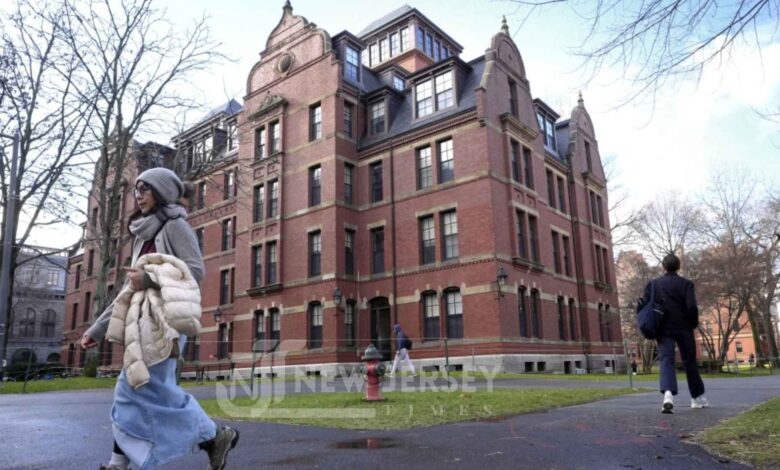
July 29 EST: The Biden-to-Trump power shift has triggered a political and legal clash over academic governance that’s now converging on Harvard University. Following a bruising $221 million federal settlement with Columbia, the Trump administration is pushing Harvard to accept an even larger deal potentially in excess of $500 million to resolve similar investigations into alleged civil rights violations, ideological bias, and federal funding compliance.

As settlement talks intensify behind closed doors, Harvard stands at a legal and political crossroads, fighting to preserve its independence while under mounting pressure from a White House determined to make an example of America’s most prestigious universities.
Columbia Deal Sets Precedent
In July 2025, Columbia University agreed to a sweeping $221 million settlement with the federal government to restore access to more than $400 million in frozen federal research grants. The agreement included $200 million paid directly to federal agencies and another $21 million set aside for discrimination claims from faculty and staff.
But the financial terms were only part of the story. According to The Guardian, the Columbia deal came with strict reforms: the adoption of a federal definition of antisemitism, a rollback of DEI (Diversity, Equity, and Inclusion) initiatives, mandatory oversight of international student admissions, and curriculum revisions related to the Middle East.
For President Donald Trump, the Columbia case has become a political template and a springboard.
White House Targets Harvard Next
The Trump administration is now leveraging Columbia’s precedent to demand an even bigger payout from Harvard, which reportedly had over $2.3 billion in federal research grants frozen earlier this year, according to Wikipedia. The freeze was part of a broader crackdown on what the administration has framed as “institutional discrimination” and “ideological intolerance” on elite campuses.
Negotiations between Harvard and the White House began in July, though terms remain unresolved. According to The Harvard Crimson, Trump is personally pressing for a record-setting deal, both to punish what he’s described as “woke elites” and to reinforce the administration’s legal power over federal education funding.
Trump’s Education Secretary Linda McMahon has described the Columbia settlement as a “roadmap” for future agreements with other institutions. McMahon, a longtime ally of Trump from her days leading the Small Business Administration and WWE, has reportedly advocated for aggressive federal oversight tied to compliance with civil rights statutes and free speech protections.
Harvard’s Legal Counterattack
Harvard, for its part, isn’t folding. In April 2025, the university filed a federal lawsuit claiming that the White House’s actions specifically the funding freeze and threats to its international student program and tax-exempt status constituted unconstitutional government overreach. A federal judge heard arguments in July, but has not yet issued a ruling.
Harvard’s public statements have been sparse. While it has not denied that talks are underway, it has also not confirmed any willingness to accept the administration’s conditions. Still, as reported by Inside Higher Ed, sources close to the university suggest it is open to a settlement approaching $500 million more than double what Columbia paid.
To that end, Harvard has already begun preemptive concessions. As reported by Campus Reform, the school recently adopted the federal definition of antisemitism, scaled back DEI staffing, and initiated internal reviews of its Middle Eastern studies programs.
A Deal That Could Reshape Higher Ed
If Harvard does strike a deal, the implications would reach far beyond Cambridge.
According to The Wall Street Journal, the administration is crafting a broader strategy to enforce financial and structural reforms on any university receiving federal funds. The threat of massive settlements combined with bureaucratic compliance mechanisms could become a new normal in federal-university relations.
Some university officials see it as an existential moment. As Nature reported, the Columbia deal has left many academic administrators in a state of panic. Several institutions, particularly those with large federal science grants, are quietly preparing for similar enforcement actions.
But critics argue that these settlements are more about politics than policy. In a blistering piece for New York Magazine, legal scholars and civil rights groups warned that the Columbia agreement resembled a coerced capitulation one that threatens academic freedom and enshrines ideological conformity.
Still, for a Trump-led White House, the endgame is about power and precedent. As the administration continues to draw battle lines with elite academia, it views Harvard as the ultimate prize and a litmus test for how far federal leverage can go.
For now, the question is whether Harvard will pay to end the war or fight it to the bitter end in court.
New Jersey Times Is Your Source: The Latest In Politics, Entertainment, Business, Breaking News, And Other News. Please Follow Us On Facebook, Instagram, And Twitter To Receive Instantaneous Updates. Also Do Checkout Our Telegram Channel @Njtdotcom For Latest Updates.

Trained in war zones, raised in Newark, and seasoned in city hall, Jordan blends grit reporting with deep integrity. From floods to finance bills, they’re always first on scene and last to leave.

A political science PhD who jumped the academic ship to cover real-time governance, Olivia is the East Coast's sharpest watchdog. She dissects power plays in Trenton and D.C. without bias or apology.