
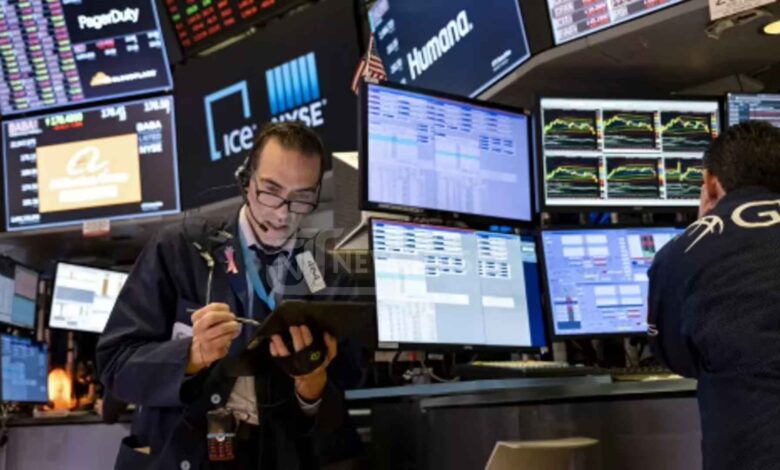
Middle East tensions market impact was front and center Friday, as Wall Street closed lower and oil prices surged, reflecting investor unease over a potential escalation in the Israel–Iran conflict.


The S&P 500 edged down 0.2% to finish around 5,968, while the Nasdaq dropped 0.5% to 19,447. Energy stocks rallied on the back of an 11% weekly gain in crude, while tech lagged. The Dow managed modest gains, buoyed by defensives.
SPY and QQQ Reflect Defensive Drift
ETF proxies told the same story. The SPDR S&P 500 ETF (SPY) closed at $594.28, down modestly after hitting a session low of $592.92. The Invesco QQQ (QQQ), tracking the Nasdaq 100, finished at $526.83, after spending the day trading between $524.93 and $533.51. Volumes were high—investors aren’t tuning out, they’re bracing.
Friday was the first full trading day after the Juneteenth holiday, and the market tone was cautious. U.S. fighter deployments in the Gulf and fears over oil supply disruptions set the backdrop. Traders don’t need a headline to sell—they just need a plausible scenario.
Oil Surges, RBC Models a 20% Drop
Oil prices surged nearly 11% this week. That’s not just a headline stat—it’s a red flag for corporate margins, transportation costs, and inflation expectations. RBC Capital laid it out bluntly: if this conflict expands, the S&P 500 could drop as much as 20%. Their model assumes oil above $110, an earnings slowdown, and a multiple reset.
That kind of drawdown isn’t baked in yet, but you can see the hedging. Defense names, energy plays, and cash-rich balance sheets outperformed. High-multiple tech—long duration, highly sensitive to rate and sentiment swings—took a hit.
Deutsche Bank: It’s the Oil, Not the Missiles
Not every desk is bearish. Deutsche Bank, per Financial Times, noted that markets typically recover from geopolitical shocks unless energy supply takes a lasting hit. But that’s a big if. A few disrupted cargoes or a Gulf blockade changes the calculus fast.
The wild card? The U.S. response. President Trump signaled this week that action—military or otherwise—could come within two weeks. That’s now a market timeline. Short-dated options are pricing in movement. Institutional flows show portfolio reshuffling. Nobody’s waiting for a formal announcement to move risk around.
Tech Cools, Value Gets a Lift
Big Tech, which has carried markets all year, finally hit resistance. The Nasdaq’s half-point loss Friday doesn’t sound like much, but it came with serious volume in names like Nvidia, Microsoft, and Meta. When leadership fades and energy climbs, the message is clear: portfolios are tilting toward safety.
Value stocks, particularly those tied to commodities and industrials, found a bid. Not because growth is suddenly back—but because they offer earnings stability when volatility rises. It’s not bullishness. It’s triage.
The Setup for Next Week
No Fed speakers, no earnings surprises—just geopolitical drift and rate sensitivity. Traders are watching crude, defense policy, and the bond market for clues.
If oil keeps rising, expect more flows into energy and defense. If there’s clarity on U.S. involvement—or de-escalation—expect a reflexive rally in tech. But for now, the bet is caution.
Markets aren’t panicking. But they’re absolutely paying attention.
New Jersey Times Is Your Source: The Latest In Politics, Entertainment, Business, Breaking News, And Other News. Please Follow Us On Facebook, Instagram, And Twitter To Receive Instantaneous Updates. Also Do Checkout Our Telegram Channel @Njtdotcom For Latest Updates.

A Wall Street veteran turned investigative journalist, Marcus brings over two decades of financial insight into boardrooms, IPOs, corporate chess games, and economic undercurrents. Known for asking uncomfortable questions in comfortable suits.