
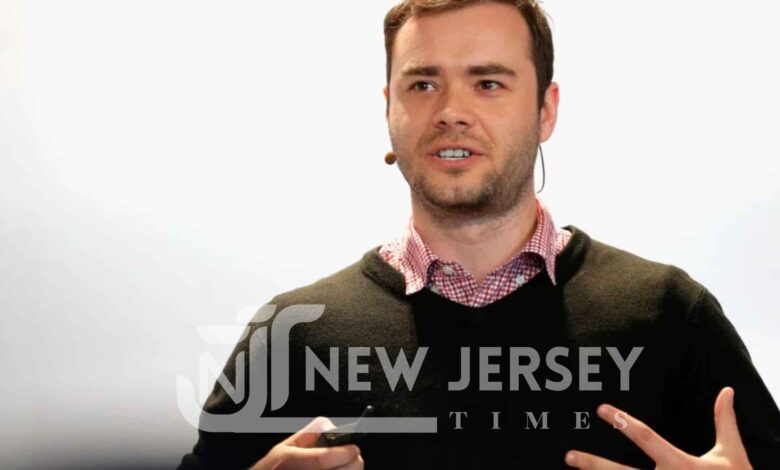
Trenton, May 20: There are personnel moves in Silicon Valley, and then there are moments that reorder the competitive map of an entire industry. On Tuesday morning, Andrej Karpathy posted a quiet, two-sentence update on X announcing he had joined Anthropic. The reaction was anything but quiet. Within the hour, practically everyone working on frontier artificial intelligence had an opinion about what it meant.

That kind of response does not happen for most hires. It happened for this one, and for good reason. Karpathy, a founding member of OpenAI, a former director of AI at Tesla, and one of the most influential research figures in the modern era of machine learning, is now working at Anthropic full-time. He will be focused directly on the pre-training of Claude, the AI model family that has quietly become one of the most commercially successful and technically respected in the world.
The announcement, as reported by multiple outlets including Axios, TechCrunch, CNBC, and Fortune, sent a clear message to the industry: Anthropic is not just competing with OpenAI. It is pulling ahead on the dimension that arguably matters most in this race, which is talent.
A Career That Reads Like a Blueprint for Modern AI
To understand why Tuesday’s announcement carried the weight it did, you have to understand who Andrej Karpathy actually is. Not as a job title or a list of credentials, but as a figure who has genuinely shaped how modern AI systems are built, taught, and understood.
Karpathy completed his Ph.D. at Stanford University in 2016, with studies focused on convolutional and recurrent neural networks and their applications in computer vision and natural language processing. He joined OpenAI as a founding research scientist that same year, becoming part of the original group that launched the organization when it was still a bet rather than a phenomenon.
He left OpenAI in 2017 to join Tesla. His work there took on a character that most academic researchers never encounter. He was not running experiments in a controlled lab setting. He was making neural networks function reliably on real roads, inside real cars, at a scale that few researchers ever touch.
He led the computer vision team behind Autopilot and Full Self-Driving, programs that placed his work directly in front of millions of consumers. He spent five years doing exactly that.
After leaving Tesla in 2022, he returned to OpenAI for approximately a year before departing again in February 2024 to found Eureka Labs, an AI-focused education startup. That project generated significant attention but limited public updates. As of this week, according to reporting by TechCrunch, the future of Eureka Labs is unclear. Karpathy has not publicly addressed whether he will continue with it. For now, Anthropic has his full attention.
The Specific Role, and Why It Matters More Than the Headline
The details of what Karpathy will actually do at Anthropic deserve more attention than the announcement itself has received. He is joining Anthropic’s pre-training team, led by Nick Joseph, another former OpenAI researcher and an early Anthropic employee. Pre-training is the phase where foundational model development happens. It is where a model absorbs language, reasoning patterns, factual associations, and the general shape of human knowledge, before any fine-tuning, safety filtering, or product-level polish ever enters the picture.
It is also one of the most expensive and compute-intensive phases in the entire process of building a frontier model. The decisions made at this layer carry downstream consequences for everything built on top of it.
According to an Anthropic spokesperson, as reported by TechCrunch, Karpathy will immediately begin building a new team with a specific and notably recursive mandate: using Claude itself to accelerate the research that produces the next version of Claude.

That is not a minor operational detail. It is a strategic thesis. The conventional wisdom in the AI race has been that progress is primarily a function of compute. More chips, more power, more training runs. Anthropic, by hiring Karpathy and assigning him this specific mission, is signaling that it believes there is a smarter path. One that uses AI-driven automation to run faster experimental cycles and identify improvements in training configurations and data strategies that would otherwise demand enormous human researcher time.
Karpathy is one of the very few researchers who can bridge the gap between theoretical understanding of large language models and the practical demands of large-scale training. That combination is rarer than most outside the field appreciate.
The Autoresearch Project: The Experiment Behind the Hire
The hire makes even more sense when placed alongside work Karpathy was doing independently before arriving at Anthropic. In early March 2026, he released an open-source project called autoresearch, described in reporting by Fortune as the intellectual backbone of his new role. The concept was straightforward in description and remarkable in result.
Karpathy took an AI coding agent, gave it a small language model, a frozen evaluation metric, and a fixed compute budget per experiment, then let it run entirely unsupervised for two days. The agent ran approximately 700 individual experiments and identified 20 distinct optimizations on its own. When those optimizations were applied to a larger model, training time was cut by eleven percent.
He described the method, with characteristic irreverence, as “part code, part sci-fi, and a pinch of psychosis.” The technique became known informally as the Karpathy Loop. The implications, if that method can be scaled and systematized inside a well-resourced frontier lab with access to Anthropic’s compute infrastructure, are significant. Accelerating pre-training research through AI-assisted experimentation could reshape the economics of model development across the entire industry. That is now his job.
The Talent War Is the Real War
Karpathy’s arrival sits inside a much larger pattern that has been building for months. As reported by The Next Web and Axios, Anthropic has emerged as a magnet for elite technical talent at precisely the moment its chief rival, OpenAI, has been experiencing an extended string of high-profile departures. Over the past two years, OpenAI has reportedly lost more than a dozen senior executives and researchers.
Former CTO Mira Murati departed in September 2024 and has since been building a stealth AI startup. Reinforcement learning pioneer John Schulman, an OpenAI co-founder who briefly joined Anthropic in 2024, subsequently left and is reportedly now joining Murati’s venture. Most recently, three senior OpenAI executives left on a single day in April 2026.
The cumulative picture is one of organizational turbulence at a company that was, not long ago, considered the unassailable center of gravity in the AI industry.
Anthropic, meanwhile, has been pulling talent in from across the field. According to reporting by The VC Corner, chief technology officers from Workday, You.com, Instagram, Box, Super.com, and Adept AI have all left prominent leadership roles at their respective companies to join Anthropic. Not as executives. As individual contributors doing research.
These are not people chasing titles. They are people choosing to work on hard problems at a company they apparently believe is where the most important AI research is happening right now. Separately, Anthropic also announced this week the addition of Chris Rohlf to its frontier red team, the group responsible for stress-testing advanced AI models against severe adversarial threats. Rohlf brings more than 20 years of cybersecurity experience, including time at Yahoo’s internal security group and six years at Meta.
One hire on capability. One hire on safety. That combination maps precisely onto how Anthropic has described itself since its founding in 2021 by Dario Amodei, Daniela Amodei, and other former OpenAI researchers.
The Commercial Picture Behind the Research Headlines
Karpathy’s move does not exist purely in the realm of research prestige. It sits against a financial backdrop that would have seemed improbable even eighteen months ago. As reported by Sherwood News, Anthropic recently raised capital at a valuation approaching $950 billion, placing it above OpenAI in private market terms. According to The VC Corner, the company has reached approximately $30 billion in annualized revenue, reportedly surpassing OpenAI in growth velocity.
The firm is also reportedly exploring a public offering that could come as early as late 2026, according to The Next Web. On the infrastructure side, Anthropic struck a deal earlier this month to rent compute capacity at xAI’s Colossus 1 data center in Memphis, Tennessee, reportedly doubling the rate limits on Claude Code, the company’s coding assistant. The deal was notable not only for its scale but for its counterintuitive nature, given that Colossus 1 was built by Elon Musk’s xAI operation, a competitor to both Anthropic and OpenAI.
Business, as it turns out, moves on its own schedule regardless of what competitive dynamics might suggest. The three variables that most analysts agree determine who wins a frontier AI race are compute, data, and talent. Anthropic has been accumulating all three simultaneously. Karpathy’s arrival puts the talent column into the sharpest relief yet.
The Public Intellectual Who Happens to Build Models
There is one dimension of Karpathy’s profile that rarely gets discussed in coverage of AI personnel moves, but which matters considerably for Anthropic’s broader standing. Since leaving Tesla in 2022, Karpathy built one of the largest and most respected public followings in technical AI education. His YouTube channel and online course, Neural Networks: Zero to Hero, has drawn tens of thousands of students learning to build neural networks from scratch in code.
His explanations of transformers, attention mechanisms, and the inner workings of large language models have been described by practitioners as clearer and more practically useful than most academic papers covering the same material.
He also coined the term “vibe coding” in February 2025, describing the practice of letting an AI model write code while the human follows the output intuitively rather than directing it line by line. The phrase spread across the developer community with unusual speed. Collins Dictionary reportedly named it Word of the Year.
That blend of deep technical credibility and genuine public accessibility is genuinely rare. Most researchers who can do what Karpathy does at the pre-training level are not also the person explaining those same concepts to a general technical audience on a Tuesday afternoon.
Karpathy is both. His presence at Anthropic is a research asset, but it is also a reputational and cultural one. Still, he was careful in his Tuesday post to note that the educational work is not finished, only deferred. He wrote that he remains deeply passionate about education and plans to return to it in time. Given his history of following through on exactly those kinds of commitments, that is a meaningful signal.
What Comes Next
For now, the practical questions are relatively straightforward. Karpathy has started work this week. He is reporting to Nick Joseph on the pre-training team. He is building a new group focused on using Claude to run autonomous research loops at the pre-training level.
Whether those efforts yield a public research paper, a methods release, or simply a future version of Claude that performs measurably better than what came before, the results will likely not be visible to the outside world for some time.
That said, the structural story is already clear. Anthropic is betting that the next decisive gains in frontier AI will come not from outspending rivals on raw compute, but from building smarter research infrastructure using the models it has already built.
Karpathy’s specific background, the autoresearch experiments, the deep pre-training knowledge, and the rare ability to move fluidly between theory and large-scale practice, makes him the most plausible person to test that thesis at the highest level.
The AI race is frequently framed in terms of product launches, benchmark comparisons, and funding announcements. Those things matter. But as Tuesday’s news made clear, the more foundational competition is for the small number of people in the world who actually know how to push the frontier forward. Anthropic, this week, added one of the best.
New Jersey Times Is Your Source: The Latest In Politics, Entertainment, Business, Breaking News, And Other News. Please Follow Us On Facebook, Instagram, And Twitter To Receive Instantaneous Updates. Also Do Checkout Our Telegram Channel @Njtdotcom For Latest Updates.

A Wall Street veteran turned investigative journalist, Marcus brings over two decades of financial insight into boardrooms, IPOs, corporate chess games, and economic undercurrents. Known for asking uncomfortable questions in comfortable suits.

Trained in war zones, raised in Newark, and seasoned in city hall, Jordan blends grit reporting with deep integrity. From floods to finance bills, they’re always first on scene and last to leave.